
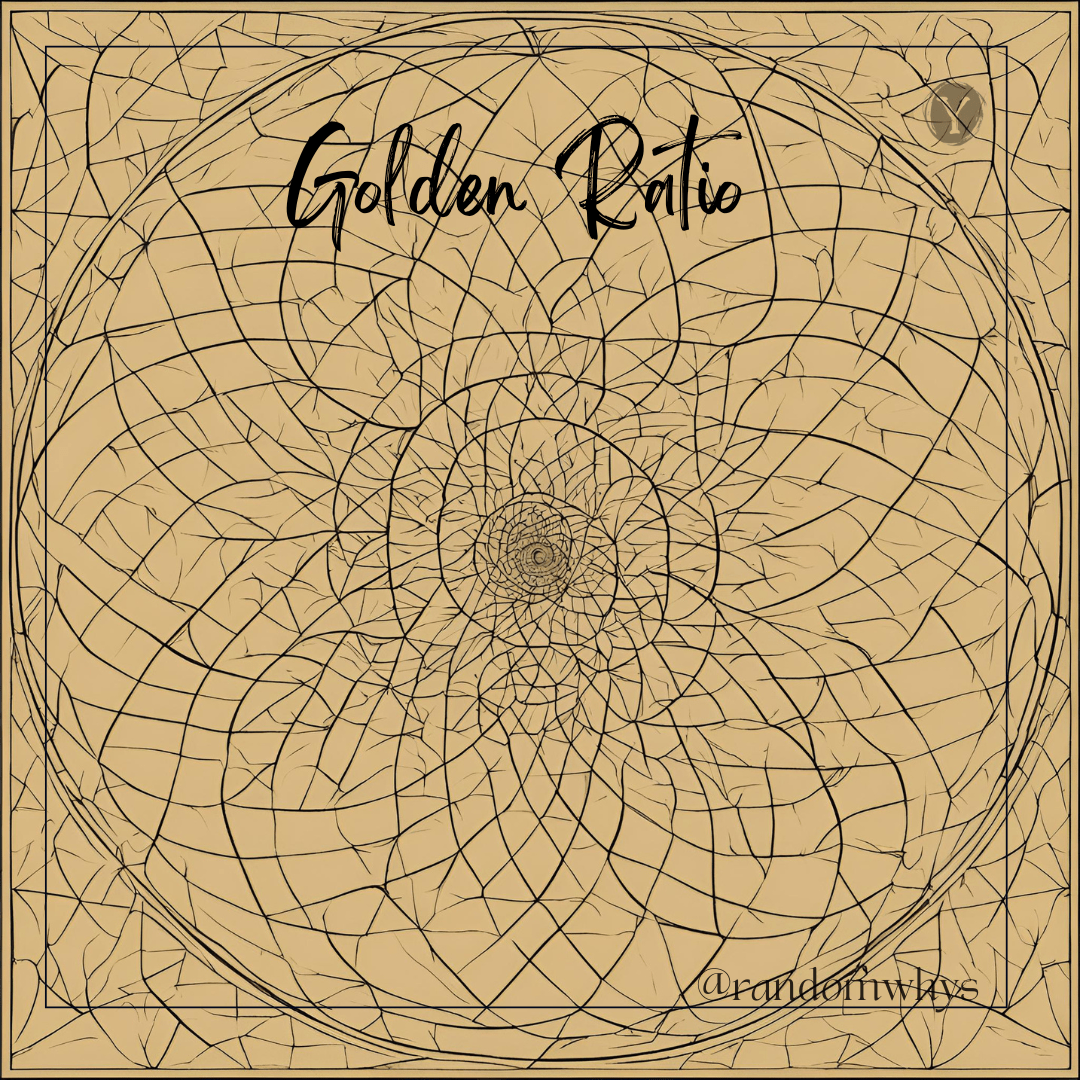
The universe is vast and mysterious. Many things make you feel amused by their beauty. Paintings of Leonardo da Vinci (Mona Lisa, Last Supper, and Vitruvian Man), a spiraling galaxy, a sunflower, aloe, pine apples, cones, shells, petal arrangements, a pyramid, etc.) are alluring and delightful.
What is the link between a spiral galaxy and a human face or a sunflower?
When these objects are looked at closely, the common thing that is found among all of them is the golden ratio.
A golden ratio is an irrational number that’s approximately equal to 1.618. It is represented by the Greek symbol Phi. It is found when a line is divided into two parts and when the total length of the line is divided by the long part of the line equals the long part of the line divided by the short part of the line.

This golden ratio is more prevalent, and it is used by many architects, such as on the Pyramid, Parthenon, and Big Temple at Thanjavur. The elements on the plants, animals, buildings, or objects are arranged and adjusted based on this ratio, creating a sense of harmony and making things attractive. It’s not that everything has a golden ratio, but there are a few things that do.
Golden Ratio and Fibonacci Series
The Fibonacci series is a sequence of numbers (1, 1, 2, 3, 5, 8, 13, 21, 34, 55, 89, and so on). When you add the last two numbers, you will get the next number, and the ratio of these is 1.6.
1 + 1 = 2, 1 + 2 = 3, 2 + 3 = 5, 3 + 5 = 8, so on
3/2 = 1.5, 5/3 = 1.6, 8/5 = 1.6, so on
It is also called nature’s universal rule.
Leonardo Pisano Bogollo
The Fibonacci sequence was developed by Leonardo Pisano Bigollo, also known as Leonardo of Pisa and Fibonacci (which means “son of Bonacci”). Liber Abaci (the Book of the Abacus) is a famous book published by him. It demonstrated how superior the Hindu-Arabic arithmetic system was to the Roman numeral system, and it demonstrated how the Hindu-Arabic arithmetic system could be employed to benefit Italian merchants. The Fibonacci sequence evolved from a mathematical problem about rabbit mating posed in the Liber Abaci.
This sequence and the golden ratio are used by artists, architects, and designers to make things look captivating.

Pic credit: Here
Here are a few examples.
Fibonacci Day is observed on November 23 because the dates are written as 11/23.
Cheers!
PS: I still remember when I was struggling to get an output of this series without error in MATLAB.
Don’t miss out! Get notified about new blog posts straight to your inbox ! (No spam, pinky promise!)
Enter your email below to receive updates

 Random Whys
One thought on “Why is it called the golden ratio?”
Comments are closed.