
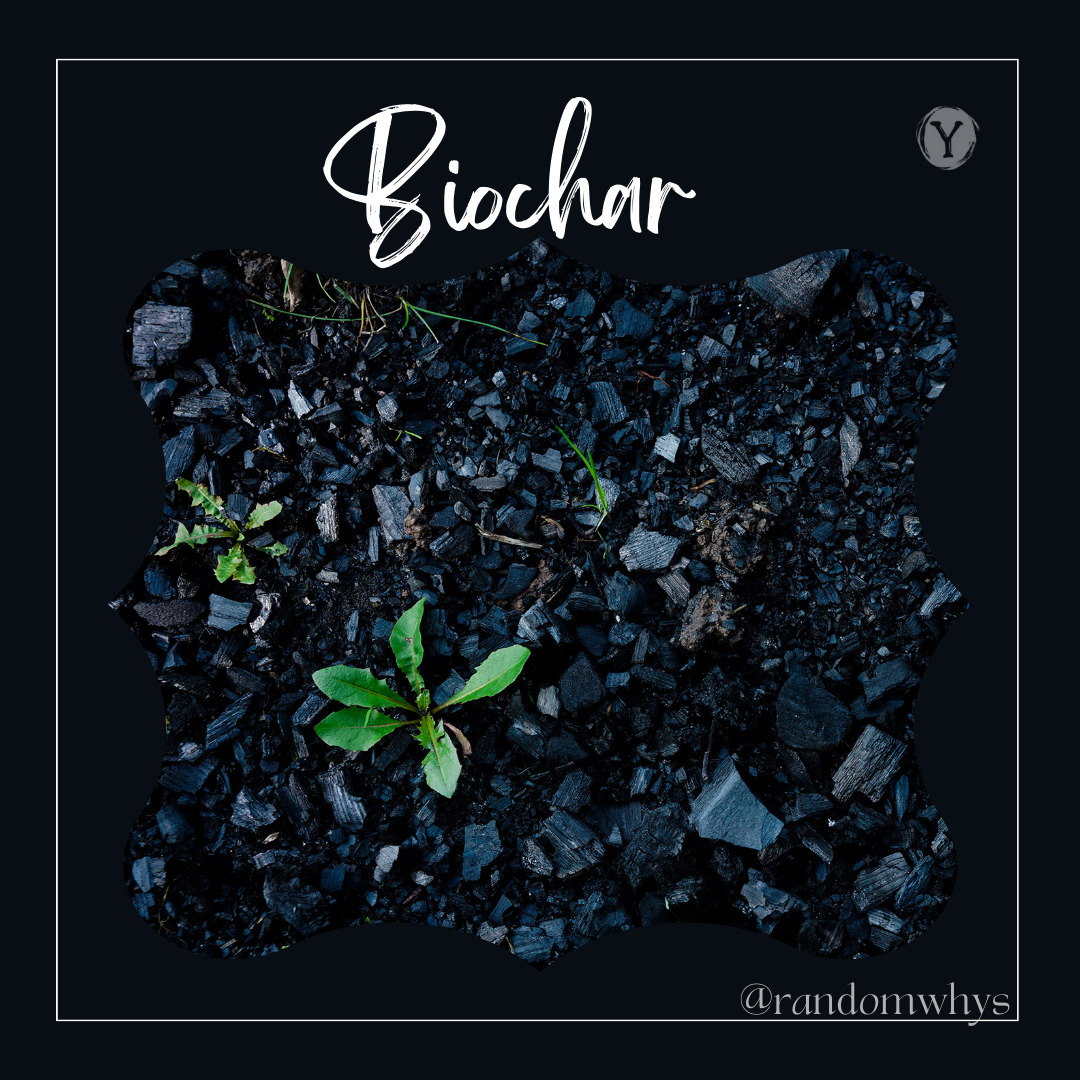
As we continue to struggle with the challenges of climate change, food insecurity, and waste management, a promising solution emerges: biochar. This carbon-rich material is produced by heating organic materials like agricultural waste, wood, or manure in an oxygen-limited environment. This offers a unique approach to tackling these pressing issues simultaneously.
Definition
Biochar is defined as a stable form of carbon created by heating organic materials (such as wood, crop residues, and manure) in the absence of oxygen. This process, known as pyrolysis. This converts biomass into a material that can be incorporated into soils to improve their physical and chemical properties.

Origin
The concept of biochar is rooted in ancient agricultural practices. Although the term “biochar” is relatively modern, the principles behind its use date back centuries.
#Terra Preta Soils: The origin of biochar can be traced back to the Amazon Basin, where ancient civilizations created fertile soils known as Terra Preta (dark earth). These soils were enriched with charcoal, organic matter, and nutrients, making them significantly more productive than surrounding soils.
#Traditional Practices: Similar practices have been observed in other parts of the world, including Africa and Asia, where burned biomass is added to soils to enhance fertility and sustain agricultural productivity over long periods of time.
Modern Rediscovery
#Scientific Research: In recent decades, scientific research has rediscovered and validated the benefits of these ancient practices. Modern studies have shown that biochar can improve soil structure, increase water retention, and reduce the need for chemical fertilizers.
#Environmental Benefits: Biochar’s ability to store carbon has also attracted attention in climate change mitigation. By converting biomass into a stable form of carbon and storing it in the soil, biochar can help reduce atmospheric CO2 levels.
Properties of Biochar
Biochar has a highly porous structure, which significantly enhances its ability to retain water and nutrients. Biochar can vary in particle size depending on the feedstock and pyrolysis conditions. Smaller particle sizes increase surface area but may also affect soil aeration and compaction differently than larger particles. Biochar is primarily composed of carbon (C), often more than 70% by weight.
Generally, biochar contains small amounts of essential nutrients, but its main benefit is enhancing the soil’s nutrient-holding capacity rather than directly supplying nutrients. While biochar is rich in carbon, its nutrient content (nitrogen, phosphorus, potassium, or NPK) can vary based on the biomass source. Not all biochar’s are the same.
Biochar Production
It is a thermochemical process called pyrolysis, where biomass is heated in an oxygen-limited environment at temperatures ranging from 300°C to 700°C (572°F to 1292°F). This process decomposes the organic matter and releases volatile compounds. Meanwhile, it leaves behind a highly stable form of carbon known as biochar. It is available as briquettes or granules.

Various types of pyrolysis systems can be used, ranging from simple earth mound kilns to sophisticated industrial-scale reactors. Some of them are:
- Biochar Retort: Biochar retorts are airtight containers made to externally heat biomass and induce pyrolysis. This method is known for producing high-quality biochar with minimal emissions. The gases released during the process are often collected or burned to sustain the operation. This makes retorts both environmentally and economically advantageous. Retorts are suitable for small-scale and commercial biochar production due to their controlled environment and high yield.
- Biochar Stove: Biochar stoves, such as Top-Lit Updraft (TLUD) stoves and Anila stoves, serve dual purposes. This produces both heat for cooking and biochar as a byproduct. TLUD stoves create a stratified combustion environment with distinct zones for biomass, flaming pyrolysis, gas combustion, and charcoal combustion. Anila stoves, on the other hand, use concentric cylinders to pyrolyze biomass, with the escaping gases enhancing the cooking flame. These stoves are particularly beneficial in rural and low-income areas, providing an efficient cooking method while producing biochar for soil amendment.
- Biochar Kiln: Biochar kilns, such as the Kon-Tiki cone kiln, are built for larger-scale biochar production. These kilns create an oxygen-limited environment through a cone-shaped, open-top design. The primary fire burns at the top, and biomass is added gradually. This technique is well-known for producing biochar quickly and cleanly. This makes it perfect for use in communal and agricultural settings.
- Biochar Oven: Biochar ovens are simple, low-tech devices intended for small-scale biochar production. These ovens are ideal for small farmers and urban gardeners. They can handle a variety of feedstocks, such as agriculture residues and yard waste.
Uses of Biochar
We will explore the simple and practical ways biochar can be used. From improving soil health and growing better crops to cleaning water and managing waste, biochar is a versatile and powerful resource. Let’s explore the various applications of biochar.
#Fuel
In most cases, the biochar is used as a soil amendment rather than a fuel. Coal and charcoal are different from biochar. Coal is a fossil fuel used mainly for energy production and industrial applications. It was formed from ancient plant material over millions of years. It is mainly used for electricity generation and industrial applications due to its high energy density. Whereas charcoal is produced by pyrolyzing wood. It is mainly used as a fuel for cooking and heating.
#Crop yield
Biochar primarily improves nutrient retention and soil structure, indirectly benefiting plant growth. Biochar’s porous structure improves soil aeration, water retention, and microbial habitat, leading to better root development and nutrient uptake. Generally, biochar contains small amounts of essential nutrients, but its main benefit is enhancing the soil’s nutrient-holding capacity rather than directly supplying nutrients. It is not the same as compost. The compost is rich in nutrients and organic matter, enhancing the soil’s fertility. It also improves microbial activity.
#Soil Remediation
Biochar can trap heavy metals and organic pollutants, reducing their bioavailability and toxicity in contaminated soils. Its large surface area and cation exchange capacity help adsorb contaminants. Because biochar frequently has a high CEC, it can retain vital nutrients and release them gradually to plants. Additionally, the pore sizes range from macropores to micropores, providing an extensive surface area for microbial colonization and nutrient adsorption. Moreover, biochar usually has an alkaline pH, which can help to neutralize acidic soils. The exact pH can vary depending on the feedstock and pyrolysis conditions.
#Carbon Sequestration
The high carbon content makes it a stable form of carbon sequestration, contributing to its environmental benefits. Biochar retains the carbon from biomass, preventing it from decomposing and releasing CO2 back into the atmosphere. When applied to soil, biochar acts as a stable carbon sink. Biochar effectively removes carbon dioxide from the atmosphere and stores it in a stable form. This carbon capture makes biochar a valuable tool in the fight against climate change and improving soil health and fertility.
#Water Treatment
Biochar’s porous structure and large surface area make it effective in adsorbing contaminants from water, including heavy metals, pesticides, and organic pollutants. The pore sizes range from macropores to micropores, providing an extensive surface area for microbial colonization and nutrient adsorption. Biochar can also retain nutrients in water, preventing eutrophication in water bodies by capturing excess nitrogen and phosphorus.
#Waste Treatment
Biochar can be used in filtration systems to remove contaminants from wastewater, including organic and inorganic compounds. Biochar can be produced from organic waste materials, converting waste into a valuable product while reducing landfill use and methane emissions from decomposing waste.
How to use?
Obviously, the recommended application rate varies for crops, but a general guideline is to mix biochar with compost or soil at a rate of 5–10% by volume. For specific crops or soil conditions, the rate may be adjusted based on field trials and local recommendations. Mixing it with compost or something else, helps to avoid temporary nutrient lock-up, where biochar initially absorbs nutrients from the soil, making them unavailable to plants. It can be used as top dressing too.
Commercialization and Adoption
While biochar is not yet widespread, its adoption has been growing in recent years. Several countries, including the United States, Canada, the United Kingdom, Germany, Australia, China, and Japan, have established biochar companies and startups that produce and market biochar products for agricultural and horticultural applications.
In India, efforts to commercialize and promote the use of biochar are also underway. Research institutions, government initiatives, biochar companies, NGOs, and farmer groups have been working on them.
Challenges and Opportunities
Biochar has many potential uses, but before it can be widely used, a number of challenges must be resolved. These obstacles include the need for standardized production methods, consistent quality control, cost-effective distribution systems, and increased awareness among farmers and policymakers.
However, with ongoing research and development, supportive policies and incentives, and collaborative efforts among stakeholders, biochar has the potential to become a significant contributor to sustainable agriculture and climate change mitigation efforts.
Biochar is a comprehensive solution that addresses the critical issues of climate change, soil degradation, and waste management. Biochar, which converts biomass waste into a stable form of carbon, not only reduces carbon emissions but also improves soil health and productivity.
As the world strives for sustainable food production and environmental solutions, biochar represents a promising approach that is consistent with the principles of the circular economy and regenerative agriculture. With continued research, commercialization efforts, and policy support, biochar has the potential to play a critical role in creating a more sustainable and resilient future for agriculture and the environment.
Cheers
Thank you for reading ♡!
If you found this helpful, please give it a thumbs up and share it with anyone who might find it useful!
If you like what you see and wish to support my work, then
Share your thoughts/suggestions at the comment section or mail at
randomwhyss[@]gmail[dot]com
Reference
- Lehmann, J., & Joseph, S. (Eds.). (2024). Biochar for environmental management: science, technology and implementation. Taylor & Francis.
- Lehmann, J., & Joseph, S. (2015). Biochar for environmental management: an introduction. In Biochar for environmental management (pp. 1-13). Routledge.
- Ok, Y. S., Uchimiya, S. M., Chang, S. X., & Bolan, N. (Eds.). (2015). Biochar: Production, characterization, and applications. CRC press.
- Sohi, S. P., Krull, E., Lopez-Capel, E., & Bol, R. (2010). A review of biochar and its use and function in soil. Advances in Agronomy, 105, 47-82.
Don’t miss out! Get notified about new blog posts straight to your inbox !
(No spam, pinky promise!)


 Random Whys
One thought on “Biochar: Sustainable Agriculture!”