
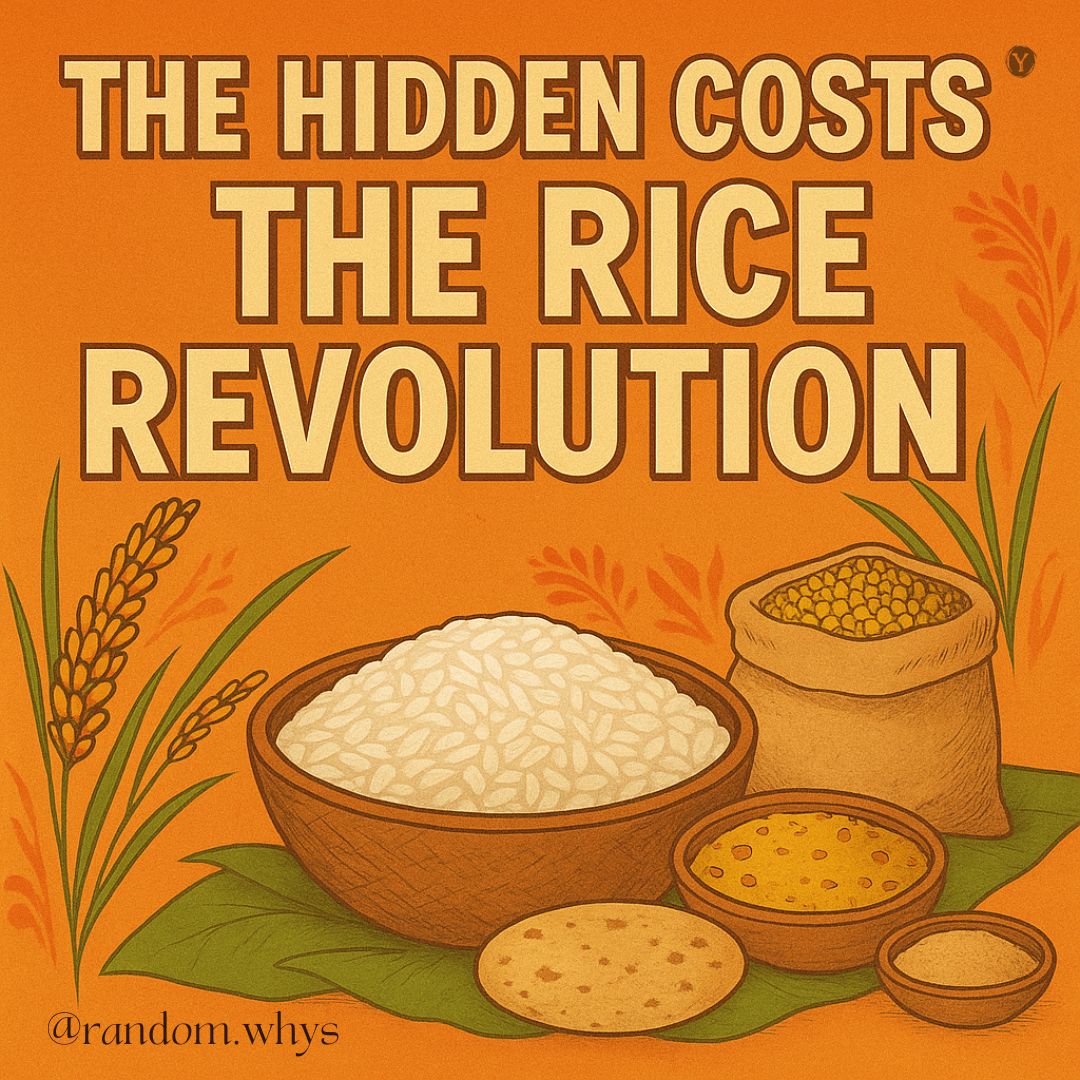
I was trying to find an alternative to rice in my diet. At first, I thought lunch was the main issue. But when I traced it back, rice was everywhere. Breakfast, dinner, snacks, even in quick bites we don’t notice. That’s when it hit me. Rice isn’t just a grain on the plate but it has intricated into our entire lifestyle.
But this wasn’t always the case. Pre–Green Revolution, India was more millet country. In 1960, per capita millet consumption was around 30.9 kg/year, making up nearly 40% of cultivated grains. By 2022, that dropped to 3.8 kg/year and just 20% share of cultivation. Rice and wheat took over, reshaping not just what we eat but how our farms, markets, and health systems function.
Erosion of Agrobiodiversity
The Green Revolution was a band-aid and necessary to escape famine and achieve national self-sufficiency. But in the process, we lost sight of balance. Hybrid rice and wheat varieties were pushed aggressively, leading to the loss of over 100,000 indigenous rice varieties and countless traditional millet seeds. Each of those varieties carried resilience against pests, droughts, and climate swings.
The new seeds were designed for fertilizers and pesticides. Fertilizer use in India is projected to cross 160 kg per hectare by 2030, with some states already touching 250 kg/ha. Pesticide production hit 258,000 metric tons in 2023, applied over more than 108 million hectares. Farmers are trapped in a cycle more chemicals, declining soil health, shrinking microbial life, and polluted water.
The Shift on our plates & and in our bodies
Millets are rich in fiber, magnesium, and antioxidants, with a glycemic index of 52–68. White rice sits at 73, triggering sharp blood sugar spikes. The shift from complex, high-fiber millets to polished rice is directly linked to India’s rising diabetes burden. Multiple studies confirm that higher white rice consumption raises Type-2 diabetes risk, particularly in South Asian populations. In short, the grain that saved us from famine is now pushing us towards lifestyle disease.
Rice, methane, and the climate Story
It doesn’t stop at health. Rice paddies are major methane emitters. CH₄ emissions from Indian rice fields rose from about 3.7 teragrams (3.4–4.1 Tg) in 1966 to 4.8 teragrams (4.4–5.3 Tg) in 2017, largely driven by the expansion of rice area and conventional water regimes. Every plate of rice carries a hidden climate cost.
Millets, by contrast, are dryland crops. They thrive with little water, demand minimal inputs, and release negligible methane. They’re not just good for us, they’re good for the planet too.
The capitalist squeeze
The Green Revolution was also India’s industrial revolution in agriculture. Surplus production, mechanization, monoculture, and integration into global markets. Farmers who once saved seeds became buyers of hybrids they couldn’t replant. Multinationals selling fertilizers and pesticides turned farming into a business model.
Was the green revolution the mistake?
No. It was the need of the hour like a band-aid to stop famine and ensure national food sufficiency.
The mistake was never going back to rebuild what we lost. Millets could have been renewed, seed diversity could have been conserved, but policy and markets stayed stuck on rice and wheat.
Question of time and who cooks?
Even if we talk about bringing millets back, a practical question comes up. Who will cook them? Millets often need soaking, longer cooking, and extra attention. If we’re not careful, this shift risks pushing the responsibility back onto women, who already carry the weight of kitchen work. That’s not the future we want.
The real opportunity lies in innovation. With rice, we created an entire ecosystem, instant mixes, snacks, packaged foods, ready-to-cook and ready-to-eat products. Millets deserve the same treatment. From millet noodles to quick-cook flours, the scope is massive. This isn’t just about food, it’s a space for entrepreneurs, startups, and farmer collectives to build the millet economy. Convenience is what will make millets mainstream again.
Where do we go from here?
- Bring millets into PDS, mid-day meals, and urban shelves.
- Support community seed banks to revive traditional varieties.
- Reform subsidies so they reward soil health, not just fertilizer use.
- Make millets aspirational with recipes, ready-to-cook products, and modern branding.
The Green Revolution was the need of the hour. But what we forgot to do was renew millets alongside. We replaced a diversity-rich food culture with monocultures. We traded resilience for yields, and long-term health for short-term survival. Now we need a Nutritional Revolution that restores balance to our diets, our farms, and our future.
Cheers
Check out the previous posts: #DecodeAgri04: Who will grow the crops in a world obsessed with tech? & Why hardest way is the smartest way!
If you like what you see and wish to support my work, then
Share your thoughts/suggestion at the comment section or mail at
randomwhyss[@]gmail[dot]com
Don’t miss out! Get notified about new blog posts straight to your inbox !
(No spam, pinky promise!)
Enter your mail to receive updates


 Random Whys
3 thoughts on “#Decodeagri18: Hidden costs of the rice revolution!”