
Every farm tells a different story. For decades, the battle against weeds are going on as they compete against the nutrients, sun, water. space and more. We having tackling them with the herbicides.
#Herbicide Era
Farmers were able to manage and destroy the weeds in the fields with limited labor. The herbicides are available in different formulations and targets the specific weeds. Decades later, these chemical herbicides caused
- Residues (Food & Soil)
- Air Quality
- Resistant to herbicides and requiring strong formulations
#Innovations
Recently, terms like carbon-based inputs, thermal destruction and electroporation are being used to kill the weeds instantly. There are few companies and startups working on the same. All these technologies focuses on reducing the labor, supporting microbial life, leaving the soil undisturbed, and reducing the chemical load.
Mechanism: High powered CO2 lasers are used to identify the weeds using AI. It hits the meristem of the weed’s growing point in milliseconds with concentrated beam of thermal energy. It is designed for large lands and quite expensive. It is heavy duty tractor pulled unit and quite expensive.
ii. Azaneo
Mechanism: It deploys the procedure used in the medical fields such as electroporation (Electroportation – branding). Most of the electroporation is temporary or reversible (Electric field is applied to a cell to increase the permeability/open cells to insert DNA or medicine). Here irreversible electroporation is used to target the cell membrane. This raise the temperature of the weeds and destabilizes it. They use high voltage pulses to determine the required electricity for different weeds. It is a unit attached to a tractor, less expensive compared to Carbon robotics and uses less energy.
#The Gap in Indian context
The big tech meets with Indian farming systems, its often a fantasy or disaster. Most of the them are small and marginal farming lands with irregular edges and varying crop spacing. These above said units are too heavy for the tractors and on the farmers wallet.
#Indian Innovations
iii. Harvested Robotics : Rakshak
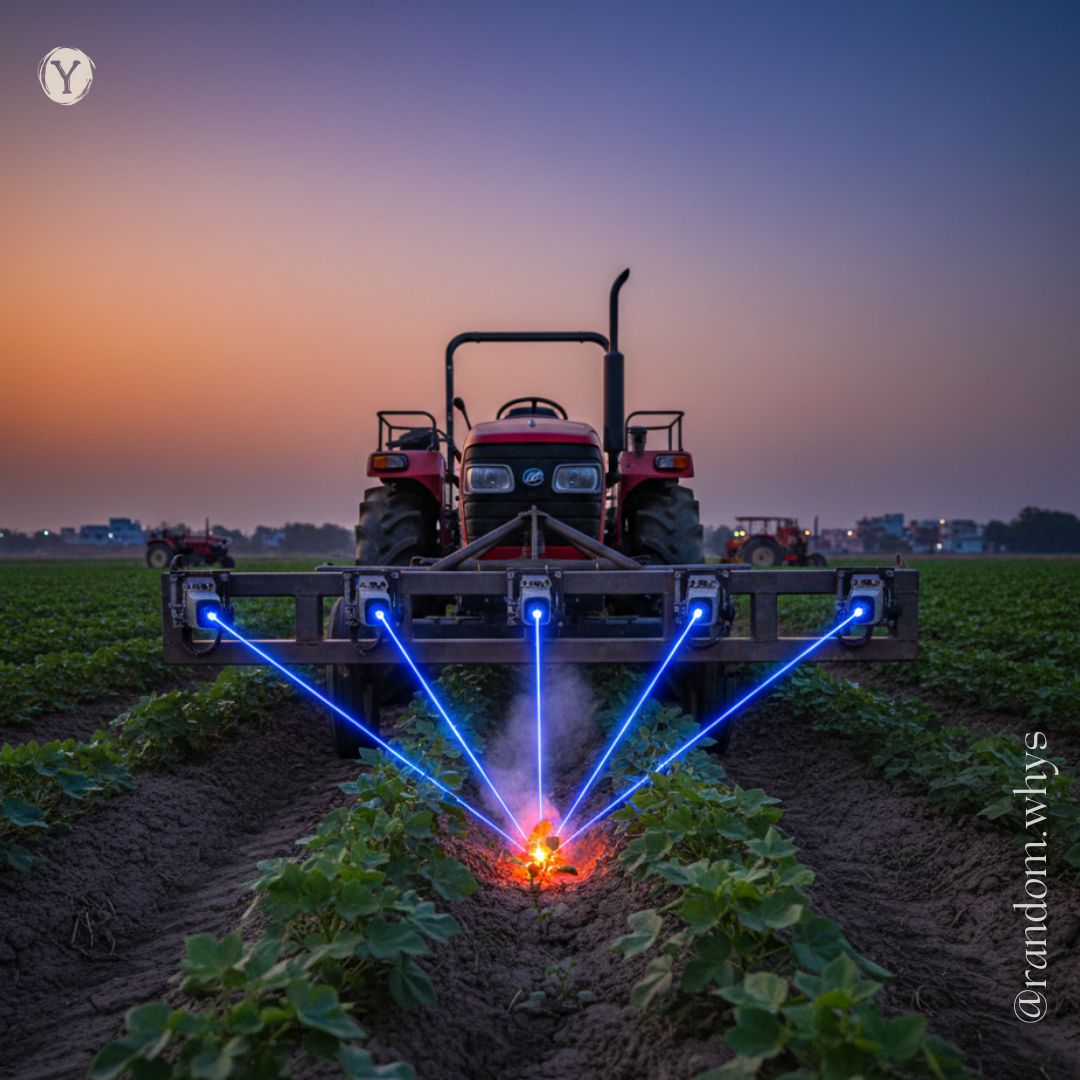
Mechanism: It is tractor mounted and runs on tractor’s power. It uses the blue lasers (not fixed, can move left or right to spot) to target the xylem (water carrying cells) of the weeds and kills and thereby cutting the plants ability to transport. This has multiple smaller laser units to distribute the heat load so that it can operate in Indian summers.
Crops: Cotton, Sugarcane and Onions
They are yet in the market, focusing on FPO and dealers.
#Ground Issues
- Dust and Mud on the lens
- Identification of the weeds (Varies with region, and soil)
- Upfront cost
- Basics of the operation/maintenance
- Accuracy
#Tech vs Nature
As we watch this transition, agriculture seems to stand between two expanding worlds.
- The High-Tech Path: AI, lasers, sensors and electroporation. It is clean, precise and saves us from chemicals.
- The Regenerative Path: Natural farming, organic, living soil and conserving the entire biodiversity and ecosystem. Here the weeds becomes the cover crops if soil health is managed properly.
Are we in a transition? Not sure if it is towards a single winner or hybrid path. But we are moving away from the chemical era.
Cheers
Check out the similar posts: #DecodeAgri21: Are we all just saying the same thing? & other Agri posts
Previous post: Beginner’s Struggles
If you like what you see and wish to support my work, then
Share your thoughts/suggestion at the comment section or mail at
randomwhyss[@]gmail[dot]com
Don’t miss out! Get notified about new blog posts straight to your inbox !
(No spam, pinky promise!)
Enter your mail to receive updates


 Random Whys
2 thoughts on “#DecodeAgri22: The War on Weeds!”