A Suitable Boy (2020) Review

The Netflix series “A Suitable Boy” based on Vikram Seth’s novel follows Lata’s quest for love in 1950s India. While visually stunning, character depth and storytelling may not fully align with the original book.

3–4 minutes

It is a novel written by Vikram Seth and published in 1993. I wasn’t even born then. I haven’t read this book, but I heard it has around 1500 pages. It’s not about the book, but rather a review of the series released on Netflix. 

It is a limited series focusing on a young girl named Lata who is trying to find a suitable boy for her. This story has rich and unique characters and revolves around the 1950s. The visuals were appealing. I felt like the series focused on two characters that ran parallel. One is Maan, young and unaware of his actions and consequences. and the other is Lata, an English literature graduate.

This series, though revolving around the 1950s, might resonate even now. Maybe that’s how Indians’s moms are conditioned. lol.  The way she is careful and cautions their sons and daughters. Even at the scene, it was mentioned that we all become ma’s at some point in time. 

She meets three men in different situations. Kabir Durrani, with whom she falls in love; Amit Chatterjee, her sister’s in-law’s brother; and Haresh Khanna, her mother’s choice. Meanwhile, Maan falls in love with Saeeda Bai. Maan did justice to his role.

Other characters, Meenakshi Mehra, Mrs. Mahesh Kapoor, Rasheed, and Bhaskar (the young kid) did well. The music was appealing, especially with the Saeeda Bai scenes.

TBH, I watched this series after seeing a reel on how a woman advises Lata on finding a suitable boy. Find a boy who gives you space to grow. Such things are hard to find, but they exist. But I wanted the series; it wasn’t as expected. 

Kabir was self-centered, Amit wasn’t serious yet, and I loved the way he asked, May I?. Haresh is, of course, dedicated, kind, and sincere. I couldn’t understand or get a hold of it when she chose Haresh. The reason she told her mother was that he loved her a lot. She did mention that love should make you feel at ease and calmer. Yet, those lines didn’t agree with scenes of picking Haresh as her suitable men.  I guess the original copy would have done justice to the reason for her pick. Nonetheless, his efforts and reflections on his behavior are to be appreciated. 

Some parts were funny yet musing, where Lata’s mother checked for his certificates, place of work, home, and everything. She was very cautious, calculative, and whining.  The role of the abusing uncle and the way it had impacted her.

Another thing that did surprise me was Maan. His passion for Saeeda was beautifully portrayed. Saeeda was fabulous. He was cautious and aware at the beginning that he was about to commit a crime. But at the end, he commits the same mistake without a second thought. 

Some scenes were abrupt, and the language was very heavy. They could’ve used some simple sentences with a high vocabulary. But here, certain dialogue is very long. I am sure no movie or series could do justice to a book. 

I remember reading two states in a book by Chetan Bhagat. Movies tried but couldn’t match it. If possible, I will try to read to understand the author’s world and his reason for why Lata picked Harish. Do give it a try. It’s available on Netflix.

Cheers!

Happy Weekend! Check out the other movies

Don’t miss out! Get notified about new blog posts straight to your inbox !

(No spam, pinky promise!)

Enter your mail to receive updates

If you like what you see and wish to support my work, then

Share your thoughts/suggestion at the comment section or mail at

My Unexpected Break

The writer apologizes for being busy with work. They reflect on a 30-day blogging challenge, new experiences, and new changes.

1–2 minutes

I would like to apologize for my abscond. Lol. This week, work has kept me busy. I wanted to write on that challenge that I did it to myself. To write blogs for 30 days while distancing myself from social media and to gain clarity on life events. If you’re wondering how it went, still figuring it out. Life doesn’t always feed you with answers, right? But those 30 days were truly wonderful.

I met new people, made new friends, spent some quality time alone and with my dog, read books, wrote blogs and some fearful experiences.

Over the past ten days, I took a much need break. Maybe the longest one I’ve taken from Randomwhys. Those days, No. I should say as, social media consumed those ten days. Instagram, X, movies, series and drama kept me hooked. Good one are Maxton hall (highly recommended) and lovely runner (watch at 2x). Others, I don’t remember.

I’ve also started a new job, which involves research and has kept me quite occupied. I am still adjusting to the new schedule and things. Hope it goes well. (Touchwood)

I’m unsure if I can commit to daily blog posts, but I don’t want to stop writing about sustainability, movies and poetry. I want to groom myself in these areas and will try to make time. I will be updating my social media pages, so feel free to follow them

Cheers

Happy Weekend!

Share your thoughts/suggestion at the comment section or mail at

Don’t miss out! Get notified about new blog posts straight to your inbox !

(No spam, pinky promise!)

Enter your mail to receive updates

Frame!

A nature enthusiast embraces the wilderness, capturing its beauty through photography and protecting the environment from human impact. His work reflects timeless stories.

In the curves, he sits facing the mountains.
None on the roads, green everywhere.
Crimson rays creeping out of the ranges
Cirrostratus as a cherry on top, wrapping blues.

Firm hands and eyes had distinct insights.
Guided us into the woods, a less traveled path
His domicile and the leaves were entangled
Warmth was lavishly dumped over animals

Through the thickets of darkness, he walks unfazed
Shadows deep in the night don't change the path.
Fireceful wilds, pouring rives, undaunted silence
He stands still in his might, unwavering.

For he captures beauty far and wide
At every glance, every take, barely any escapes
His lens frames the wild, serene, and profound.
Bringing out novel and timeless stories

With his gentle hands, he tends the land,
Picking up the trash from ev’ry strand possible.
No bottles, no labels, and no wrappers left behind
For the defend of the woods, in almost all acts.

Knowing to shield the woods and greens,
Answering the quests of the world's decay,
Where roads were built and trees were cut.
Yet, failing to protect him from the perils of ciggy

Cheers!

PS: Check out Dissonance & others

Past Lives Movie Review (2023): What if’s

“Past Lives” is a captivating movie about love, choices and regrets. It explores cultural identity, love, and the impact of life decisions, leaving audiences reflecting on their own journeys.

5–8 minutes

Past Lives is one of the movies you can watch on repeat. It may not be everyone’s cup of tea, but it is a great one. The movie begins with three people sitting on a table and having a conversion. Korean man and woman, and an American man. It would be hard to predict the relationship at first. A Korean man (Hae Sung), who lives with his parents, is an only son, and has a reserved personality, enjoys a drink with a set of friends.

Nora, who is Korean but is migrating to Canada at a very young age, is ambitious and has a clear set of goals. She has goals of getting Nobel price or Pulitzer or Tony awards. She never gets lied back. Arthur is American and lives in New York. The story just revolves around the three.

Hae and Nora are good friends and neighbours. They do have good bonding. The scenes clearly show at the very beginning that Nora is competitive, as when she cries about getting lower marks than Hae. She didn’t say farewell before leaving for Canada.

After 12 years, Hae ends up posting a comment on her father’s post about Nora. Then they patch up again. During that, he attends class, and she is a playwright. There was a beautiful dialogue that was said by her colleague.

The long journey of rotting

I felt that it was too connected to the movie. Then they get along, but the time zones keep them away. She struggles to communicate with him in Korea. She wants to go back to Seoul to meet him. Asks him whether he can come to NYC. As the days pass, Nora feels diverted. They ended up taking a break. There are no signs of proposing with each other or asking for anything, yet you can sense the tension.

Again, a goodbye is missed here. It is left hanging.

She moves to the writing academy. There, she meets Arthur, a fellow writer in the Academy, and gets married. Moves back to New York. Meanwhile, he moves to China and finds love. Fast forward to the next twenty years, when Hae comes to New York for a vacation.

The plot is intense here. They spend time together. They bring out all the what if questions. They did end up having some deep conversation, forgetting her husband, who was beside her. Those what if questions. What if you didn’t leave Seoul? What if I came to NYC? What if we were married? Is this our In Yan? Those questions were really touching. At last, he leaves NYC in a hope that they would be something in the next life, and she bids farewell to him.

What if this is a past life as well, and we are already something else to each other in our next life? What do you think we'll be?

I would I like share some of my observations and interpretations.

The most interesting part of the movie was Arthur. His character was commendable. Oh my god, I do not know how the writer came up with this role. And I can be very sure that this can be seen only in really good movies. I do not know if this kind of man exists in the real world. I really doubt the way he handled it so maturely.

The conversations that they had, right the way he asked her whether he was enough for him, but he feels sometimes the kind of insecurity where he finds all the negatives, and he forgets the good part that she did love him at some point in time. And that was nice when he said, ” I have trouble believing it sometimes.” At the end, when she went to drop him off at the Uber, he was waiting for her at the gate. He knew that she would come back, and the way he hugged her at the end, he never expected that. He handled it very well.

A couple stands close together on a dimly lit street in front of a staircase and a door with a gated entrance.
Nora and Arthur at the end

There’s this beautiful line where Arthur says to Nora. It really captures the complexity of their relationship.

You dream in a language that I can't understand. It's like there's this whole place inside of you where I can't go

Even when the three of them were together, Arthur said to Hae that he did the right thing. Maybe both of them wanted closure or some kind of realization. Hae just wanted to say goodbye, and Nora wants to run away from it. In childhood, then, as young adults, they never closed it, but as adults, I am not sure what I should call it. A realization that they had love for each other or a closure that the inner child in them wants. Only the writer knows!

Maybe the ending is all up to open interpretation. You can conclude that she is regretting it, or you can conclude that she has finally come to terms with him and said goodbye, or she regrets this life, or she is hoping for the next one. She said sorry to her husband, realizing that some parts of her wanted him. I don’t know. It was all up to your own interpretation. Hae didn’t cry at the end. Maybe he wanted the closure that he was looking for right from his young age, or he is hoping that they would get long in the next generation, as per In Yan.

The whole thing gets picture-perfect when Nora’s mother says that when one loses something, they gain something else. Just like the tree of life, the Buddhist philosophical concept brings into the picture that you realize that every decision that you take grows into a new branch, right? It’s hard to go back. But we take decisions with all the information that we have at that moment. Maybe that is what this life is all about.

Also, this movie made me think about something kind of out there. What if we never built this society where we’re always chasing success, money, fame, or ambition? What if we were just like animals with basic needs? Would Nora and Hae Sung have stayed together then? Lol.

It’s an interesting question because it makes you wonder how much our choices are shaped by the world we live in. The film really shows how every decision we make comes with a cost, whether it’s big or small. Both Nora and Hae Sung made choices that cost them their love.

Past Lives is a wonderful film. It leaves us contemplating our own life choices, cultural identities, and the nature of love and connection. By presenting complex characters and situations without easy answers, the film encourages introspection. It also challenges us to appreciate the paths we’ve chosen while acknowledging the poignancy of roads not taken

Cheers!

Happy Weekend! Check out the other movies

If you like what you see and wish to support my work, then

Share your thoughts/suggestion at the comment section or mail at

Don’t miss out! Get notified about new blog posts straight to your inbox !

(No spam, pinky promise!)

Enter your mail to receive updates

Unwritten Perception!

Writing transforms us and the world. Simple words effectively convey information, but poetry demands emotive language. Vocabulary evolves with writing, sparking self-discovery. Literature bridges hearts and minds.

2–4 minutes

As the days pass, one thing I remember from that writing is journey. It not only transforms the way we write but also the world around us.

At first, when I started writing, I made sure that the words were simple, understandable, and concise. I realized that was the secret to writing. And this works really well when you are writing about many contexts, particularly explaining scientific concepts, discussing climate change, agriculture, analyzing economic theories, and many more. Simple words would effectively communicate the content and reach the audience. We strive to break down intricate ideas into readable chunks. Picking straightforward words to ensure our concept reaches a broad audience.

However, when it comes to poetry, simplicity alone doesn’t help. If this resonates with you, let me know! I am not here to brag, yet even in order to write more poems, the words that provoke emotions are needed. The task here is not merely to inform but to evoke emotions. To create vivid imagery and transport the readers into a different state of mind.

For doing such a thing, simple words aren’t enough, I believe. There is a need for metaphors, smileys, rhythm, and more. Let’s say a girl is sad. This is straight to the point, and it conveys the facts. Doesn’t it connect to the reader? The answer will be no! This doesn’t convey the full spectrum of emotions that a girl is experiencing. Her agony weighed her down to ashes, which seems very connectable. This allows the readers to experience the emotions rather than knowing the existence alone.

The poet’s eye, in fine frenzy rolling, doth glance from heaven to earth, from earth to heaven. – William Shakespeare

As our writing evolves, so too does our vocabulary. We begin to seek out words that capture the precise shade of meaning we wish to convey. For example, take the word “Kalopsia.” It refers to the delusion of seeing things as more beautiful than they are. Certain words help to convey the whole picture in a single word. Another word is crimson for sunset instead of red.

The difference between the right word and the almost right word is the difference between lightning and a lightning bug. – Mark Twain

Finding the right word isn’t easy. As we struggle to find the perfect words to express our thoughts and feelings, we often learn new insights about ourselves and the world around us.

As one writes more, the perception sharpens. The variations in emotions become more noticeable. The shades of meaning in words become clearer. The impact of rhythm and structure becomes more significant. Sometimes, not following any of the rules also works well.

In the words of Charles Bukowski

Without literature, life is hell

Literature transforms the mundane into the extraordinary. It gives voice to our innermost thoughts and emotions. This even creates a bridge between writer and reader.

The blank page becomes a mirror. It reflects not only our ideas but also our perceptions, biases, and hidden truths. Through this process of introspection and expression, we grow not just as writers but as individuals.

I write to discover what I know – Flannery O’Connor

Cheers, Here, some of my Scribblings

Happy Writing!

If you like what you see and wish to support my work, then

Share your thoughts/suggestion at the comment section or mail at

Don’t miss out! Get notified about new blog posts straight to your inbox !

(No spam, pinky promise!)

Enter your mail to receive updates

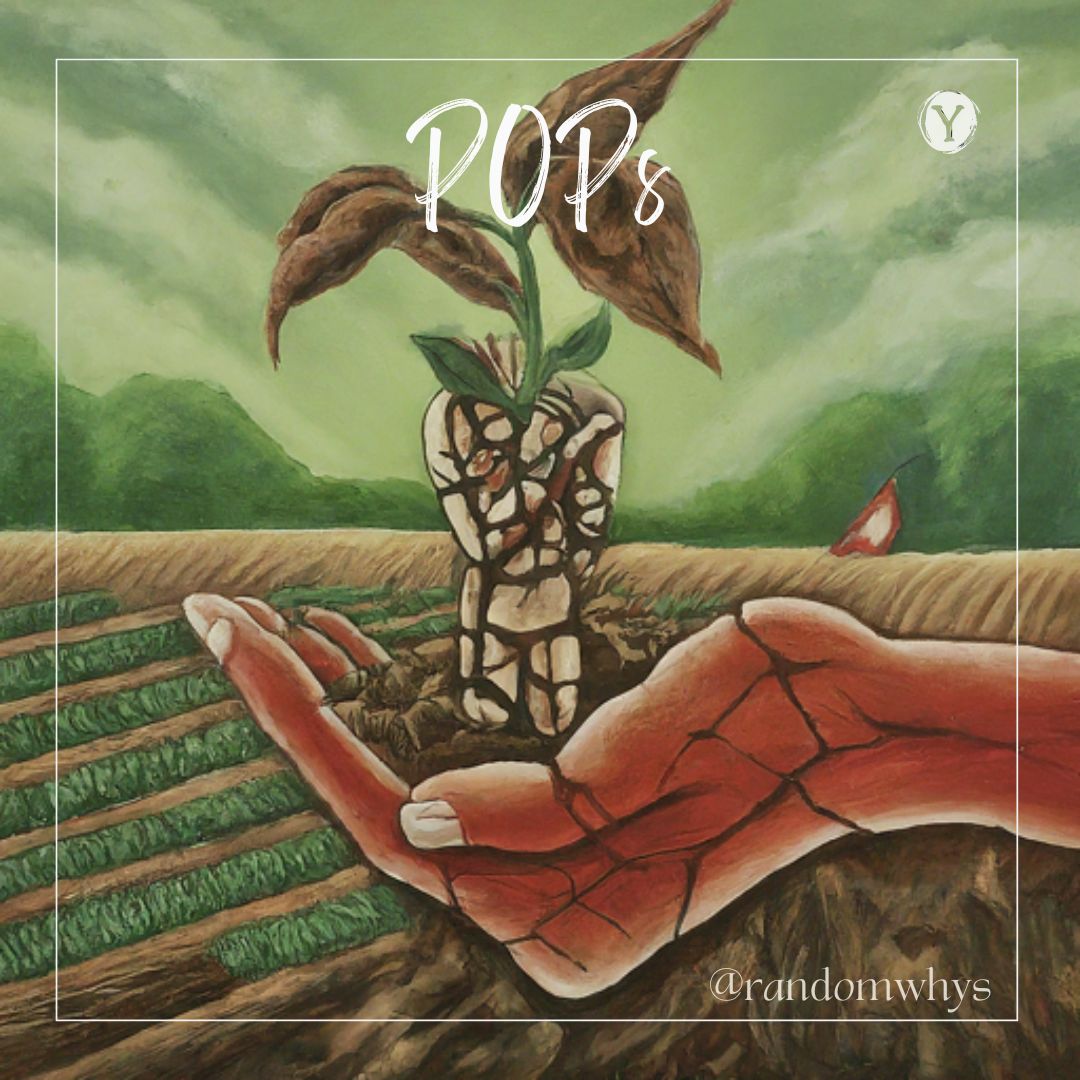
#DecodeAgri07: Persistent Organic Pollutants (POPs)

Persistent Organic Pollutants (POPs) are harmful chemicals affecting human health, the environment, and food sustainability, posing significant challenges worldwide.

7–10 minutes

With the recent technologies and innovations in our modern world, there are some drawbacks that lie beneath the surface. One such issue is called as Persistent Organic Pollutants (POPs). It is a group of toxic chemicals that pose a risk to human health and the environment. These substances stay in the environment for long periods, travel long distances through air and water, and even bioaccumulate in living organisms. Indeed, they provide benefits in agriculture and industry, but now they have emerged as formidable challenges to human health, the environment, and the sustainability of our food systems.

Persistent Organic Pollutants (POPs)

POPs are organic compounds that include a wide range of industrial chemicals, pesticides, and the byproducts of industrial processes and combustion. There are 12 initial POPs mentioned in the Stockholm convention under the major three categories. Pesticides (aldrin, DDT, etc.), industrial chemicals (hexachlorobenzene), and by-products (PCDD, PCDF, and PCBs) are mentioned in the convention. These compounds resist environmental degradation through chemical, biological, and photolytic processes. POPs have contaminated every environmental part, including air, water, and soil, even in remote areas like the Arctic and Antarctic regions.

Given the widespread use and persistence of POPs, international efforts have been made to identify and regulate the most harmful among them, known as the ‘Dirty Dozen’.

Dirty Dozen

It is a term used to describe the twelve harmful POPs identified by the Stockholm Convention. It is an international treaty aimed at restricting and eliminating the production and use of these chemicals. The Dirty Dozen includes aldrin, chlordane, DDT, dieldrin, endrin, heptachlor, hexachlorobenzene, mirex, polychlorinated biphenyls (PCBs), toxaphene, dioxins, and furans. There is a list of fruits and vegetables that are high in residues that is updated every year. Some of them include blueberries, apples, strawberries, and more. Check it out.

Environmental Impact of POPs

Soil Contamination

POPs can remain in the soil for decades and affect the soil microbial communities. They are crucial for plant growth, which leads to reduced production. For example, DDT is banned, yet it is found in soil today. Furthermore, this affects soil health.

Water Pollution

POPs accumulate in water bodies, posing a risk to the organisms in the aquatic system. Some studies show that PCBs and dioxins cause deformities and reproductive issues in fish and other organisms. It can also contaminate drinking water sources, thereby affecting human health.

Air Pollution

POPs can travel long distances with the help of the atmosphere. It can settle from the air onto the land and water, leading to widespread contamination.

Wildlife

POPs are highly toxic. They can accumulate in the fatty tissues of living organisms, and their concentration gets increased as they move up the food chain. This leads to greater levels due to biomagnification. Research has shown that levels of POPs can be up to 10 times higher in top predators like polar bears compared to their prey species, demonstrating the process of biomagnification along the food chain.

Climate change

The relationship between POPs and climate change is a complex and concerning one. The rise in temperature is causing the glaciers to melt. These can release the trapped POPs, exacerbating the environment and health.

Gender-Specific Impact of POPs

POPs have specific impacts on women and their children, especially in developing countries. POPs interfere with the hormonal system, leading to reproductive health issues. Studies show that women are associated with infertility, miscarriages, and adverse birth outcomes. Along with that, a few more research findings say that women in high exposure areas have POP concentrations in their breast milk. It is ten times higher than those in low exposure areas. One more study found that women exposed to POPs have a higher risk of developing breast cancer.

POPs affect men’s reproductive health as well. It disrupts their hormonal balance, leading to reduced testosterone levels.

Impact on Farmers

Farmers are often directly exposed to pesticides containing POPs. Studies show that farmers exposed to high levels of dioxins and PCBs are at greater risk of developing cancer.

Moreover, contaminated soils can reduce crop yield and productivity. Research findings say that POP contamination led to a 15 percent reduction in crop yields, affecting the farmer’s livelihood.

Farmers’ Dilemma

Now, let’s look at it from the farmer’s lens. The use of fertilizer and pesticides has been a long-standing practice for protecting crops from pests and diseases. This also ensures good production and productivity. This also helps them produce the crops at a commercial level across a vast area. However, with respect to environmental concerns, the transition to organic farming requires several years. They have to rely on natural fertilizers and biological pest controls, composts, crop rotation, and the use of organic matter. This phase is called the organic transition period, which is time consuming and costly.

This takes around three to five years, often leading to poor crop yields and financial problems for the farmers. It becomes troublesome for marginal and small farmers in developing countries like India who are operating on thin margins. They find themselves in a difficult position, balancing the immediate economic demands with long-term sustainable practices. Limited training, a knowledge gap, and organic inputs further exacerbate these challenges.

Bridging the Gap Between Conventional and Organic Farming

Achieving a sustainable balance between feeding the growing global population and shifting towards organic farming practices is a complex challenge. The global population is expected to reach 9.7 billion by 2050. This seems to be a challenge, especially while considering the transition. Organic farming includes the benefits of environmental protection, healthy produce, good soil health, microbial conditions, and better biodiversity. However, shifting to organic farming poses’ greater hurdles. This includes lower initial yields, lack of knowledge, financial instability, input costs, and time consumption.

Can organic farming feed the world?

Despite these challenges, certain studies suggest that organic farming can contribute to global sustainability. However, there are several factors that need to be addressed.

Yield Improvement

A yield gap study found that organic farming yield is 18.4% lower than that of conventional farming. This gap can be minimized with improved organic techniques. Apart from that, techniques such as green manure, crop rotation, and composting can improve soil fertility and structure, leading to better yields in the long run.

Research and Development

Investing more in the research and development of organic farming techniques that can help farmers increase yields. Developing crop varieties that are more resilient to pests and diseases. Exploring more bio-based pesticides, focusing on precision agriculture technologies, and finding cost-effective alternatives to POPs are also crucial.

Training and knowledge sharing

Training programs and knowledge sharing initiatives can be taken to equip farmers with the necessary skills. The process, organic certification steps, etc. should be prioritized. This can also help them understand the long-term benefits of sustainability.

Market Development

Strengthening the local and regional markets for organic produce and ensuring that small and marginal farmers receive fair prices for their products. Certification schemes, fair trade, and consumer awareness campaigns can help build a market for organic goods.

Public Awareness

Raising awareness among consumers about the risks of POPs and also the benefits of organic farming. This can drive consumer demand for safer and more environmentally conscious food products.

In conclusion, addressing the challenge of POPs requires a multi-faceted approach involving regulation, education, and innovation. This involves efforts from international organizations, the government, researchers, farmers, and even consumers. To feed the growing population while mitigating the impacts of POPs and climate change, it is imperative that we prioritize long-term sustainability over short term gains. Through concerted efforts, we can create a future where agriculture is both productive and sustainable, ensuring food security and environmental protection for generations to come.

Cheers!

Follow on IG X for more!

If you like what you see and wish to support my work, then

Share your thoughts/suggestion at the comment section or mail at

Don’t miss out! Get notified about new blog posts straight to your inbox !

(No spam, pinky promise!)

Enter your mail to receive updates

Reference

Pulsating Glaciers

Discover the fascinating world of pulsating glaciers, which can suddenly surge forward after long periods of slow movement. Learn more about these dynamic ice formations and their impact on our environment

As I was reading the book “The Midnight Library“, I came across something called pulsating glaciers. I have heard of glaciers, but not pulsating glaciers. Glaciers are enormous masses of ice that move slowly over land. They form from layers of snow that compress into ice over many years. Most glaciers flow steadily. However, some glaciers behave differently from normal glaciers. They pulse.

Pulsating glaciers, also called surging glaciers, have a unique pattern of movement. Pulsating glaciers alternate between two states. Most of the time, they move slowly or stay almost stationary. Then, suddenly, they surge forward rapidly, covering large distances in a short time. It might move up to tens of meters per day instead of just centimeters. This surge can happen over months or even just weeks.

How do they form?

The process behind pulsating glaciers involves two main phases, like the cyclical pattern.

Quiescent Phase: During this phase, the glacier builds up ice and snow. It might appear inactive, but beneath the surface, stress and pressure are accumulating.

Surge Phase: Pressure builds up internally until the ice becomes unstable. The glacier suddenly moved forward. After the surge ends, the glacier returns to a slower mode. It rebuilds mass for decades until the cycle repeats.

Why do they pulse?

The behavior of pulsating glaciers is complex. It is due to several factors.

Internal Ice Deformation: Ice deep within the glacier may distort, allowing the glacier to move.

Melting water: Water from the glacier can act as a lubricant, making it easier for the glacier to slide.

Sediments: Loose sediments or dirt under the glacier can also help it move quickly during a surge.

Other factors like bed topography, water supply, glacier geometry, and debris cover may also play a role in a cyclical surge.

Where do they occur?

Pulsating glaciers are relatively rare. They make up only a small fraction of glaciers globally. But they cluster in specific regions like Alaska (Variegated Glacier), Canada (Menyanthes Glacier), Svalbard, the Pamirs Mountain range, and even the Karakorum range (Lets explore them later).

Methods to study pulsating glaciers

Satellite imagery: Gives a broad overview and monitors changes over time.

Filed Observations: Scientists conduct field observations on glaciers in order to track and measure their movements.

GPS, drones (for precise data), and seismographs (for detecting ice quakes within the glacier) are all used.

Climate Change and Pulsating Glaciers

With rise in temperature and global warming, there are incidents of change in weather patterns. Climate change has made pulsating glacier behavior more relevant. As the world warms, many glaciers recede and lose mass overall. Surge-type glaciers in some cold environments appear to have become more unstable and surging in recent decades. Some of the reasons include,

Increased Meltwater: As the glacier melts, more water accumulates at its base, potentially triggering surges

Permafrost: Melting permafrost can disrupt glacier beds. This allows the rapid movement of glaciers during surge phases.

The Impact

Landscape Transformation: Rapid surges reshape valleys. They create new landforms like mountains and outwash plains.

Water Systems: Surging glaciers can block rivers, forming temporary lakes that might burst and cause downstream flooding.

Ecosystems: Changes in glacier behavior can the ecosystems. It affects both local flora and fauna, disturbing the normal.

Flood Risks: Sudden surges and glacial lake outburst floods (GLOFs) can damage the banks, people and infrastructure.

Water Resources: Glaciers are a vital source of freshwater. This change of behavior can impact the availability of water for agriculture and drinking.

We can reduce the emissions. Additionally, implementing the monitoring systems and early warning systems for GLOFs can protect communities around the glaciers.

Pulsating glaciers are a fascinating aspect of our planet’s ice systems. As technology advances, we will continue to uncover the mysteries behind these incredible natural phenomena. Moreover, we have to be conscious of our actions making sure that we are not accelerating the melting of glaciers.

Cheers

PS: Glaciers have names!

Thank you for reading ♡!

Like and share with it people ! Do check out the latest post on the Home page.

If you like what you see and wish to support my work, then

Share your thoughts/suggestion at the comment section or mail at

Don’t miss out! Get notified about new blog posts straight to your inbox !

(No spam, pinky promise!)

Enter your mail to receive updates

Dissonance!

A woman grapples with confusion and doubt as she questions the authenticity of her past and present.

A capture still years ago, facing the mirror
In blues and oranges, we stand closely
Smiling, hand around warm and strong
Your sparkling eyes, beautiful and kind

Heart sincere, his laughter rang
Soft gazes, plays spoke of deep devotion
A promise whispered, to the eternity
Filled with love, the day she met him last.

Yet now, another image reached her
A post that fills her with fright
Him in blue blazer, but a world away
Of beside her, a screen, a different day.

His face now dulls, puffy and worn
His eyes once vibrant, dimmed and slow
Emptiness floods in her heart, achingly,
Unable to move, frozen and detached.

Confusion rages like a stormy sea
A venomous seed, growing within
Slowing awakening her nerves through poison
She questions every truth, every memory

What is fake here? A riddle turned up
Between the smiles, that he has worn.
Which one to trust, the past or the present?
Her instincts or the vow that he has taken.

Her heart and mind were caught in tangled web
Between the darkness and the light
Are the eyes that shone for real?
Or the tired face that’s now alone?

Was that the truth? Your eyes or your smile?
The present joy or the game you played.
Are those sad eyes a trick to ensnare.
Or am I confusing the truth in despair?

Am I delusional, seeing through lies
Or was your love a clever disguise?
Are my questions the ones that are false?
Or is it your love that I shouldn’t believe?

What should I trust? Your words or laughter
Or the warmth of your eyes or manipulative plot?
My love or my instincts or the doubts that I feel
All these questions are burning me, too real to suffocate.

A larva of anguish, waiting to explode
What should I believe, which path should I go?
In this storm, where’s the shore? where’s the bliss?
But anyway, to whom should I ask all these?

Tears rolling down the swollen cheeks.
Blurring the past, the future, you and her life!

Cheers

PS: Check out Ephemeral & others

The Midnight Library: Summary

“The Midnight Library” follows Nora, who explores alternate lives in a library between life and death to find the perfect life. She learns to appreciate her decisions and the unpredictability of life.

4–6 minutes

I got the book “The Midnight Library” from a YouTube channel called The Book Show. This book is perfect for people with many regrets, who feel like they made wrong decisions, and feel useless. It tells the story of Nora Seed, a philosophy graduate in her 30s, who decides to end her life. She has lost her job, her cat died, she isn’t on good terms with her brother, she’s waiting for a friend’s reply, she gave up on music, and even her neighbor doesn’t want her around.

Instead of dying, Nora ends up in a library between life and death. This library has infinite books, each showing a different choice she could have made.  She living in a multiverse with multiple life. Mrs. Elm, her childhood librarian who was kind to her, is there to guide her. Nora has a book full of regrets, and as she explores different lives, her regrets lessen.

At first, she wishes to live with her ex-boyfriend, but he turns out to be mean. She wishes to live with her friend, but her friend died in a car accident. She tries being a pop star but feels lonely, then an Olympic swimmer but loses her mother, and even a glaciologist and a winemaker, among many others. Each life has something missing. Whenever she feels unsatisfied, she returns to the library.

Eventually, she realizes there is no perfect life. In one life, she likes being married to Ash and having a kid named Molly, with her friends alive, though her parents aren’t. Everything seems fine until she finds Mrs. Elm has died in that life. This creates a void feeling. This is a prefect life as she says. But she returns to the library. The library starts burning, and she escapes by writing on a blank page that she wants to live, saying, “I am alive.” She returns to her old life, realizing there is no perfect life, and learns to appreciate her decisions.

The story ends with her playing chess with Mrs. Elm, not knowing what her next move will be. The story might seem predictable at first, but the author’s imaginative nature keeps us hooked until the last page. It reminded me of Thoreau, and I might read his books later on. Here are some verses or lines I liked from the book.

Loneliness was a fundamental part of being a human in an essentially meaningless universe.

Go confidently in the direction of your dreams.

Doing one thing differently is often the same as doing everything differently.

Maybe in some lives you just float around and expect nothing else and don’t even try to change. Maybe that was most lives.

Never underestimate the big importance of small things.

If you aim to be something you are not, you will always fail. Aim to be you. Aim to look and act and think like you. Aim to be the truest version of you.

Disobedience is the true foundation of liberty. The obedient must be slaves.

Life isn’t simply made of the things we do, but the things we don’t do too.

Other lives that would have been different if you’d taken different directions earlier in your life. This is a tree of life.

Life is full of strange phenomena.

I never found the companion that was so companionable as solitude.

Human beings were wired to know only a hundred and fifty people, as that was the average size of hunter-gatherer communities.

Maybe it was important enough to aim to do something good. To help preserve life, in all its forms.

Sometimes just to say your own truth out loud is enough to find others like you.

I would think that the human brain can’t handle the complexity of an open quantum wave function and so it organizes or translates this complexity into something.

Everything humans see is a simplification. Minds can’t see what they can’t handle.

You are only limited by your imagination.

All good things are wild and free.

She had a fire inside her. She wondered if the fire was to warm her or destroy her. Then she realised. A fire had no motive. Only she could have that. The power was hers.

All the excellent outcomes were the result of ‘the wise choice of many alternatives.

You don’t have to understand life. You just have to live it.’ Nora shook her head. It is was a bit too much for a Philosophy graduate to take.

It’s not what you look at that matters, it’s what you see.

you could be as honest as possible in life, but people only see the truth if it is close enough to their reality.

Every life contains many millions of decisions. Some big, some small. But every time one decision is taken over another, the outcomes differ. An irreversible variation occurs, which in turn leads to further variations.

Want is an interesting word. It means lack.

We don’t have to play every game to know what winning feels like.

Cheers!

If you like what you see and wish to support my work, then

What’s your fav quote? Share it here or mail at

Don’t miss out! Get notified about new blog posts straight to your inbox !

(No spam, pinky promise!)

Enter your mail to receive updates

Under Paris Movie (2024): Sharks and Survival!

A Paris-set movie on ocean pollution becomes a thriller as sharks adapt to freshwater, wreaking havoc. A reminder on environmental conservation.

3–5 minutes

I was desperate for some rom-coms or feel-good movies. Netflix suggested a film set in Paris. The trailer showed ocean pollution, which didn’t interest me much, but I decided to give it a try rather than waste an hour finding something else.

The story follows marine biologists working to clean the oceans. Sofia, the protagonist, leads the team. The plastic pollution is clearly depicted, with a baby whale bleeding among the debris. While working, they find a shark they are monitoring.

A woman partially submerged in water with a concerned expression.
Sofia contemplates the ocean’s challenges as she navigates the polluted waters.

When the team goes down to inspect the shark, they find it much larger and huge. It is more dangerous than expected. It starts to hurt people. Sofia dives in to see what’s happening. She is also being pulled by the shark deeper, facing high pressure. Her vessel breaks under the strain, which was well-portrayed, although unrealistic since she wasn’t wearing any diving gear. She seemed pretty good after that.

Moving on, Mika, another character, injects some much-needed plot. The shark has entered Paris, adapting to fresh water and attacking people. Mika focused on cleaning the water and tracking the shark. She wants to send the shark back to the ocean. Her speech to the media is powerful and appreciated. But she should be aware, right? Better than anyone, mother sharks get territorial around their young. It’s a universal rule. Any animal would get defensive when its young were attacked or touched.

A person gently touches a large underwater creature, possibly a shark, in a dimly lit water setting.
Mika touching the baby shark

Now here’s where it gets wild. The movie introduces parthenogenesis, where sharks reproduce asexually. That is without the need for men. This concept is fascinating but rare in reality. But here’s the science: Real sharks reproduce in three ways: by laying eggs (oviparous), carrying developing embryos internally (ovoviviparous), and giving birth to live young (viviparous, very rare). They reach sexual maturity anywhere between 4 and 150 years old, depending on the species, and they can even store sperm for later use.

A distressed marine biologist examines a bloodied shark specimen in a laboratory setting.
Sofia examining the baby shark

A real case of parthenogenesis in Zebra sharks, which are typically oviparous, when captured, their reproductive systems adapt. They reproduce through parthenogenesis, and even their offspring could reproduce this way. However, these offspring were smaller and had other issues, making parthenogenesis a rare phenomenon.

Despite this, the film shows how sharks adapt to survive in fresh waters, even depicting a two-month-old shark pregnant without mating. The movie showed their crazy adaptation skills to survive.

Don’t worry! This won’t happen to humans due to genetic complexities. Gene imprinting, chromosome completion, unfertilized eggs, and so on. Even if females were captive without males, random mutations and natural selection would take much longer to cause such changes, and our lifespan is shorter.

Back to the movie, the last 45 minutes are intense. Sharks are being produced rapidly, leading to chaos. The team tries to control the situation, but the sharks prevail. The ending shows how sharks go out of control, destroying everything, including humans. The film illustrates the impact of environmental crises on animals.

A large shark emerges from the water, attacking a person among a group of swimmers.
Shark attacking the people

Ignoring its flaws, the movie effectively highlights animals’ struggles in our changing environment. Like us, they adapt to survive. We take measures like mitigating heat waves and disasters due to climate change. Animals are doing the same in their own way. If they had a sixth sense, they might urge us to protect the oceans instead of letting us pollute them.

I went in expecting a simple movie, but I came out with a deeper understanding. This film is worth watching, not just for entertainment but also for its message about environmental conservation and adaptation.

It would be better if the quote was displayed at the end (the city got destroyed and sharks were swimming around) rather than at the beginning.

We’ve got to start respecting nature and its boundaries before it’s too late. The movie might not be perfect, but it leaves you with a thought-provoking quote.

It is not the strongest of the species that survives, nor the most intelligent that survives. It is the one that is most adaptable to change. – Charles Darwin

Cheers

PS: Adil was a distraction, Lol!

Happy Weekend!

Thank you for reading ♡!

Like and share with it people !Check out our latest movie reviews!

If you like what you see and wish to support my work, then

What’s your thoughts on this? Share it here or mail at

Don’t miss out! Get notified about new blog posts straight to your inbox !

(No spam, pinky promise!)

Enter your mail to receive updates

Deadlines vs. Creativity!

Struggling to balance deadlines and creativity, a one-woman team manages writing, design, and publishing. Despite pressures, the journey is enjoyable and helps stay focused.

2–3 minutes

Deadlines and creativity can feel like extremes! I constantly struggle with keeping them balanced.

On one hand, deadlines help. They help me to plan and write, giving me that push to get things done. But deadlines can also bring kind of pressure. Sometimes, I just have to rush things. To finish writing whatever I am doing without proper editing or refinement. I experience both feelings, but yesterday was particularly challenging.

After a hectic day, I had to research, write, and publish an article – all with the looming pressure of my 30-day challenge. By the time I hit publish, it was almost midnight! 11.58 PM ! I wasn’t satisfied either.

Writing involves more than just putting words on paper. You need to gather information, create an outline, and ensure the content is original, engaging, and free of plagiarism.

As a one-woman team, I handle everything. I manage my WordPress site, design the interface (bear with me, I’m no professional UI/UX designer!), create featured images, write alt text, and make sure my content is crawled and indexed.

One reader even asked who designs everything! It’s all Canva for now, though I’d love to learn Procreate someday.

There are times when I feel deadlines hinders creativity. But in today’s world of short attention spans and information overload, deadlines are pushing us to go the extra mile.

Honestly, I don’t know where this journey will take me, but I truly enjoy the process. It is helping me stay focused. Don’t forget to check out another post (Ephemeral) I wrote today while traveling yesterday. Check it out! I haven’t sent it in the newsletter yet since I send one per day. One newsletter a day keeps the pressure away!.

How you do manage?

Cheers!

Thank you for reading ♡!

Like and share with it people ! Do check out the other posts on the Home page.

If you like what you see and wish to support my work, then

Share your thoughts/suggestion at the comment section or mail at

Don’t miss out! Get notified about new blog posts straight to your inbox !

(No spam, pinky promise!)

Enter your mail to receive updates

Ephemeral!

In the world of chaos, we share the same fate.
Bounded by the trauma, we found each other.
Scars deep down, we clung to each other.
You were my saviour; I was yours.

Mirrored agony, laughed with tears together.
Comforting and serving, we played our cards.
Bonds we shared crushed what was nearby,
The world around us crumbled, yet we remained.

Searching for the light to shape us better
Wings clipped and tethered, can't learn to fly,
Then he arrived at a different shore.
Exposing another universe, a chance to thrive.

Not love, but feeling, may be a striking spark.
A ray of hope to pull out of the dark
Fair weathered, he left along the way.
Doing some good yet breaking our fragile heaven.

True to everything, you are my anchor.
Yet a horizon beyond us whispers newness.
Wishing to sing the new songs, places to visit
To taste new adventures and experiences with you.

Let's shed these chains of dependency we share.
Heal our wounds and shattered souls.
Letting our kind spirits to sing their colors
Where we can smile, free from all.

I'll always adore what we've created this far.
The future is uncertain, new skies ahead,

Should we endure or thrive together?
As we now stand at the edge of unknown.

Cheers

PS: Check out Caged Flames & others

#DecodeAgri07: Carbon Emissions: Cycle, Capture, and Storage!

Carbon, an abundant element, crucial for life, but rising emissions pose environmental threat. Technologies aiming to capture and store CO2.

5–8 minutes

Carbon is one of the most abundant elements on Earth. The rise of carbon emissions, especially in the form of carbon dioxide, has been significant. It has also become an environmental concern with respect to climate change. Emissions have increased the CO2 concentration in the atmosphere due to human activities since the industrial period. Let’s try to understand the carbon cycle, emissions, and how they are captured and stored across countries.

The Carbon Cycle

It is a natural process that regulates the flow of carbon among land, soil, atoms, the ocean, and living organisms. It has been happening for thousands of years between the above reservoirs. This helps maintain the equilibrium state on Earth.

Atmosphere: in the form of CO2

Land: living and dead biomass like plants, animals, and soils

Oceans: CO2 dissolved in the ocean, stored under coral reefs, and more.

Rocks: Fossil fuels (decomposed organic matter)

The carbon cycle can be divided into two main components.

Fast carbon cycle: The plants absorb CO2 for the process called photosynthesis. It is converted into glucose and oxygen. This is utilized by organisms like us that require oxygen for survival. This is the rapid conversion of carbon to oxygen in the atmosphere.

Slow carbon cycle. This is a long-term process of storing carbon in rocks, fossil fuels, and deep oceans. It takes millions of years to happen.

 An illustrated diagram depicting the carbon cycle, showing the flow and storage of carbon among different reservoirs like the atmosphere, vegetation, oceans, and fossil fuels.

Increase in CO2 concentration

Burning fossil fuels, deforestation, industries, aviation, agriculture, and many human activities have disrupted the carbon cycle. Before the industrial age, atmospheric CO2 levels were around 280 parts per million. The levels have been rising and reached around 420 ppm (0.042%).

With the levels of CO2 rising, actions need to be taken to remove the excess CO2 from the atmosphere. Otherwise, it might affect the global temperature, ocean acidity, and changes in weather patterns around the world.

Major source of emissions

Energy Production: Most of the power plants use fossil fuels (including coal, oil, and natural gas). It makes up the largest source of CO2 emissions.

Transportation: Automobiles, airplanes, ships, and trains that run on fossil fuels also contribute to emissions.

Industrial Process: Manufacturing processes such as steel, cement, and certain chemicals release an amount of CO2.

To read more.

A polluted industrial site with large smokestacks emitting thick black plumes of smoke, contributing to environmental degradation and air pollution.

Carbon Capture Technologies

There are a lot of technological approaches that have been developed to capture CO2 emissions before they are released into the air. Certain approaches remove CO2 directly from the air. They are called Carbon Capture and Storage (CCS) or Carbon Dioxide Removal (CDR). It aims to capture and store it in a way that prevents it from escaping into the atmosphere. It is done in two ways.

Point source capture

Here, the CO2 emissions are directly captured from large point sources like power plants and industries. There are three major ways.

Pre combustion capture: CO2 is removed from the fuel before combustion.

Post combustion capture: CO2 is removed from the gases after combustion.

Oxyfuel combustion: Fuel is burned in pure oxygen to produce a CO2 stream.

Then it is compressed and transported through a pipeline for storage. It is usually injected underground between the rocks for permanent storage. SaskPower’s Boundary Dam project can capture around 1 million tons of CO2 per year from the coal power plant. Carbon Clean Solutions has developed carbon capture solvents (amine-promoted buffer salts) that reduce costs and increase the efficiency of CO2 capture.

Direct Air Capture (DAC)

Another technique that is gaining traction these days is direct air capture. It removes CO2 directly from the air around us. It focuses on the emissions from transportation and others.

A leading Swiss company called Climeworks uses filter material to capture CO2 from the air. The machines work on geothermal energy, which is abundant in Iceland. It has two facilities called Orca and Mammoth. The captured CO2 is then stored underground. Global Thermostat is developing direct air capture to produce carbon-negative hydrogen fuel as well as capture it for storage and utilization.

A large rooftop installation with multiple rows of cylindrical units, likely a carbon capture system designed to remove CO2 emissions.

Carbon Storage Technologies

Once the carbon is captured from the point or direct air, the CO2 must be transported and stored permanently. The most widespread storage approach is injecting it into the deep underground. It is sent into the depleted oil and gas reserves, where it can be stored for years.

Carbfix, a Swiss based company that works in conjunction with Climeworks, injects into the underground. Then the CO2 is mixed with water and reacts with basalt to form the stable carbonate minerals. It has been said that nearly 90% of the injected CO2 is mineralized within 2 years.

Other CCS Technologies

Enhanced Weathering

It involves spreading the minerals that react with CO2 over a larger surface. These minerals capture CO2 and convert it into stable forms. Heirloom does the same by grinding the minerals into a fine powder and spreading them over a large surface. It reacts and forms stable carbonates.

Bioenergy with CCS

Using biomass like wood pellets or residues from agriculture to produce biogas.

Biochar

Burning the biomass with limited oxygen to produce biochar, which can be used to store carbon.

Challenges

However, scaling up these CCS will require high costs, land, technologies, and policies, not relying on fossil fuels to run the machines. It has significant challenges to overcome and a meaningful impact on CO2 levels.

Energy Requirements

Each of these techniques and approaches has the potential. One of the important challenges is the energy required to operate them. DAC is energy intensive, as it involves large volumes of filters to absorb the CO2. In case of Climeworks, Carbfix, Iceland has lot of geothermal, so the emissions from it are very less. It would be a difficult for countries based on fossil as power source. If they are used, then the benefits of Co2 capture will be negated by the emission from the energy production. In that case, solar energy can be used. It is sustainable, abundant and cost effective making it as an attractive option. However, weather conditions, land use and initial investments are the challenges that needs to be addressed.

Scaling up and Regulation

The cost of building and scaling up carbon capture infrastructure is rising, involving financial investment, infrastructure development, and regulatory frameworks. Effective policies and incentives are crucial to drive investment in these technologies. International cooperation and agreements are necessary to standardize and regulate carbon capture practices.

The technologies are evolving to capture and store the carbon but the hurdles remain to scaling up and implementing them across. Often, this requires a multifaceted approach. While reducing emissions through cleaner energy sources and improved efficiencies is critical. This is don’t mean to keep using fossil fuel and involving increase the carbon footprint, but as a necessary complement to reduce emissions. However, challenges related to energy requirements, economic viability, and scalability need to be addressed through innovation, investment, and supportive policies.

Cheers!

PS: Some make Ink out of Carbon emissions.

Check out the other posts of Agriculture

Follow on IG X for more!

If you like what you see and wish to support my work, then

Share your thoughts/suggestion at the comment section or mail at

Don’t miss out! Get notified about new blog posts straight to your inbox !

(No spam, pinky promise!)

Enter your mail to receive updates

#DecodeAgri06: How environmental crises affect girl child marriage?

The Gender and Environment course revealed a link between droughts, floods and child marriage in developing countries, reinforcing the need for comprehensive solutions.

5–8 minutes

While studying the Gender and Environment course (UNITAR and UNCC learn), I learned that drought can lead to child marriage. This made me curious. How does drought cause child marriage? Are there studies on this? How did they find the link? Maybe it happens rarely, or it is just a case study. But when I looked it up, I found research articles on it. I decided to explore these. I didn’t want to focus only on drought because some articles also mentioned floods. So, I titled this an environmental crisis.

Droughts and floods have significantly impacted societies, especially in developing countries. One is that it is less talked about. The consequent rise in child marriage rates. Let’s try to explore how these crises force young girls into early marriages.

Child Marriage

Child marriage is defined as a formal marriage or informal union in which at least one of the parties is under 18 years. In most of the cases, girls are married at an early age. 21% of girls in the world population are married before their 18th birthday. The percentages are highest in sub-Saharan Africa and South Asia, at 35% and 30%, respectively. Almost 12 million girls are married under 18 every year. The child marriage can be due to many factors. Social pressure, norms, culture, household economics, harassments, pregnancy or other reasons. Some articles too suggest that the environmental crisis too have a impact on them.

Connection Between Drought/Flood and Child Marriage

In many farming communities, droughts or any environmental crisis can ruin crops. The well or the water sources might dry up. Even the livestock are being harmed. This causes the families to lose their income and ability to feed themselves. This pushes them into poverty. Hence, they marry off their daughter to repay the debt or to reduce family expenses.

Data & Methodology

The Sub Saharan Africa, South Asia and South East Asia were mostly covered for the studies. Majority of the articles focus more on the Qualitative data than the Quantitative data. For Quantitative, the data are collected from Demographic and Health Surveys (DHS), Standardized Precipitation Evapotranspiration Index (SPEI), Drought occurrence, Happening of child marriages and the correlation were found. Some findings did find a association to extreme heats. But most of the study focused on droughts and floods. For Qualitative, the data were collected from the interviews, surveys and focus group discussions.

STUDY TYPEAcademic11 (46%)a
Grey13 (54%)
METHODOLOGYQuantitative8 (33%)
Qualitative16 (67%)
LOCATION(S) STUDIEDSouth Asia11 (46%)
South East Asia2 (8%)
Sub-Saharan Africa13 (54%)
Rest of World0 (0%)
ENVIRONMENTAL CRISIS TYPECyclone2 (8%)
Flood8 (33%)
Drought12 (50%)
River Erosion1 (4%)
Earthquake/Tsunami1 (4%)
Extreme Heat1 (4%)
Doherty, et al (2023)

The Impact & The Findings

Environmental crises such as droughts and floods have a devastating impact on developing countries. When these occur, it affects the basic needs of the families. In those situations, child marriages serve as a coping mechanism. This helps them reduce their economic burden and also protects them from sexual exploitation and violence. Study findings say that daughters were married earlier in Bangladesh after cyclones. In Bangladesh, for example, girls aged 11-14 were 50% more likely to marry during a heatwave that lasted over 30 days. Girls aged 15-17 were 30% more likely to marry in those conditions. They just see this as a way to reduce their dependents, and it gives them temporary relief.

Another study found that droughts lead to more child marriages as families. As they cope with income loss from failed crops​.

In Somalia, climate disasters have displaced millions of people, leading to an increase in child marriage in refugee camps. Young girls are often married off to older men in exchange for food and other basic necessities.

Environmental disasters create a ripple effect that goes beyond immediate needs. Schools often close due to damage or displacement, disrupting girls education. Some think that marrying off protects them from violence. But there are possibilities for the girls to face the risk while traveling to fetch water and woods for the family. Education is denied to the them, making them more unaware of the environmental disasters. They are exposed to exploitation and trafficking and more.

Additionally, based on sample from 180 countries, a study concluded that climate change makes communities more vulnerable, especially financially. This lower income strengthens the main reasons why child marriage happens. One is the unequal treatment of girls and boys (gender discrimination) and second one is extreme poverty.

Conversely, the marriage instead of protecting them, perpetuates the cycle of poverty for those girls, their offspring, and their communities. Losing educational opportunities makes the problem worse since education helps delay marriage and empower girls​.

Wicked Problem

Climate change, environmental disasters are often considered wicked problem. Wicked problems are something difficult to define and solve because of its interconnected nature. It can’t be a one step solution or end card to that problem. Solving these kind of problems requires coordinated efforts across multiple sectors. It is associated with various factors like social norms, gender discrimination, lack of educational opportunities, poverty, weak law enforcement, and long-held cultural practices. It requires long-term coordination across policy, grassroots level, legal reforms, social protections and building climate resilience together.

Comprehensive approach

Awareness Campaigns: Educating the girls on importance of studies and the benefits of delayed marriages. Ensuring them girls can continue their education, even during crises.

Legal Frameworks: Strengthening laws to prevent child marriage. Most of the countries have a limit of 18. Effective communication to the people about the legal age for marriage.

Community Engagement: Raising awareness among the people about the negative impacts of child marriage. Also promoting gender equality can change social norms.

Economic Support: Providing financial help and livelihood support to families and farmers affected by drought can reduce the economic pressure to marry off daughters early.

The relationship between environmental crises and child marriage highlights the complexity of this issue. Child marriage, especially in the context of environmental crises, is a wicked problem. No single solution will work. It needs awareness, strict policy enforcement, and particularly in developing countries that often lack the necessary measures to protect vulnerable children. The futures of untold girls around the world depend on the world community.

Cheers!

Follow on IG X for more!

If you like what you see and wish to support my work, then

Share your thoughts/suggestion at the comment section or mail at

randomwhyss[@]gmail[dot]com

Don’t miss out! Get notified about new blog posts straight to your inbox !

(No spam, pinky promise!)

Enter your mail to receive updates

REference

  • Amin, S., Asadullah, M. N., Hossain, S., & Wahhaj, Z. (2017). Eradicating child marriage in the commonwealth: is investment in girls’ education sufficient?. The Round Table106(2), 221-223.
  • Doherty, F. C., Rao, S., & Radney, A. R. (2023). Association between child, early, and forced marriage and extreme weather events: A mixed-methods systematic review. International Social Work, 00208728231186006.
  • Ohio State University. (2023, August 29). Extreme weather events linked to increased child marriage. ScienceDaily. Retrieved June 10, 2024 from http://www.sciencedaily.com/releases/2023/08/230829124821.htm
  • Girls Not Brides. (2022). Drought, Drop Out and Early Marriage: Feeling the Effects of Climate Change in East Africa.
  • Pope, D. H., McMullen, H., Baschieri, A., Philipose, A., Udeh, C., Diallo, J., & McCoy, D. (2023). What is the current evidence for the relationship between the climate and environmental crises and child marriage? A scoping review. Global public health18(1), 2095655.
  • Pasten, R., Figueroa, E., Muñoz, D., & Colther, C. (2020). Not a dream wedding: The hidden nexus between climate change and child marriage (No. wp508).
  • UNICEF. (2022). Child marriage on the rise in Horn of Africa as drought crisis intensifies

Caged Flames!

A woman, confined by norms, marvels at fearless feminists’ confidence and strength. Doubts and fears cloud her mind, but hope lingers for a liberating future.

In a quiet suburban area, the skies are turning crimson.
She walks alone on the terrace in the warm breeze.
Barely grazing her face, yet leaving her perplexed
While protecting her with norms and traditions.


She wonders at the women who stand so boldly.
These feminist stories are flaming fierce fully.
Their confidence burns bright and strong.
As they pass their storm with audacity.


Of choices they make, their future taking flight,
With ease and elegance, as if their norm?
Career or life, they grasp with both hands.
No whispers and boundaries confine them
.

Skies dimming, shadowing the lanes of suburban
She feels confining and restricted by invisible walls.
Her heart and body were heavy and suffocating.
Doubts and fears hold her tight, destroying.


With her eyes brimming with tears, she thinks
What fuels their strength? Chasing away the fears.
Is it their birthplace? Stoking their desires.
Or their loving parents with caring hands?


Is it their environment? Or the city grands?
Or their inner strength, which they count on.
Is their beauty? Or a physical grace they hold?
Or are they simply out of luck?


As she questions, insecurities and fears creep in.
Making her awful and shrinking her power.
Are her dreams too big or her spirit too small?
Or has she yet to hear her own call?


It started to fade black, but those inquiries remain.
Her burdensome expectations and limitations.
Forcing her wings to fit in the cage.
Yet deep down, her hopes were smouldering
.

Torn between admiration and self-doubt’s sting
She yearns for freedom and to find her inner wing.
For though her past might hold her tight
But a bright future looks liberating.


To break the bonds and walk her path
She must embrace her courage and seize.
To soar like those flames, bold and brave.
To make her own, a fearless choice, someday.

Cheers!

PS: Check out Silent Echoes & others