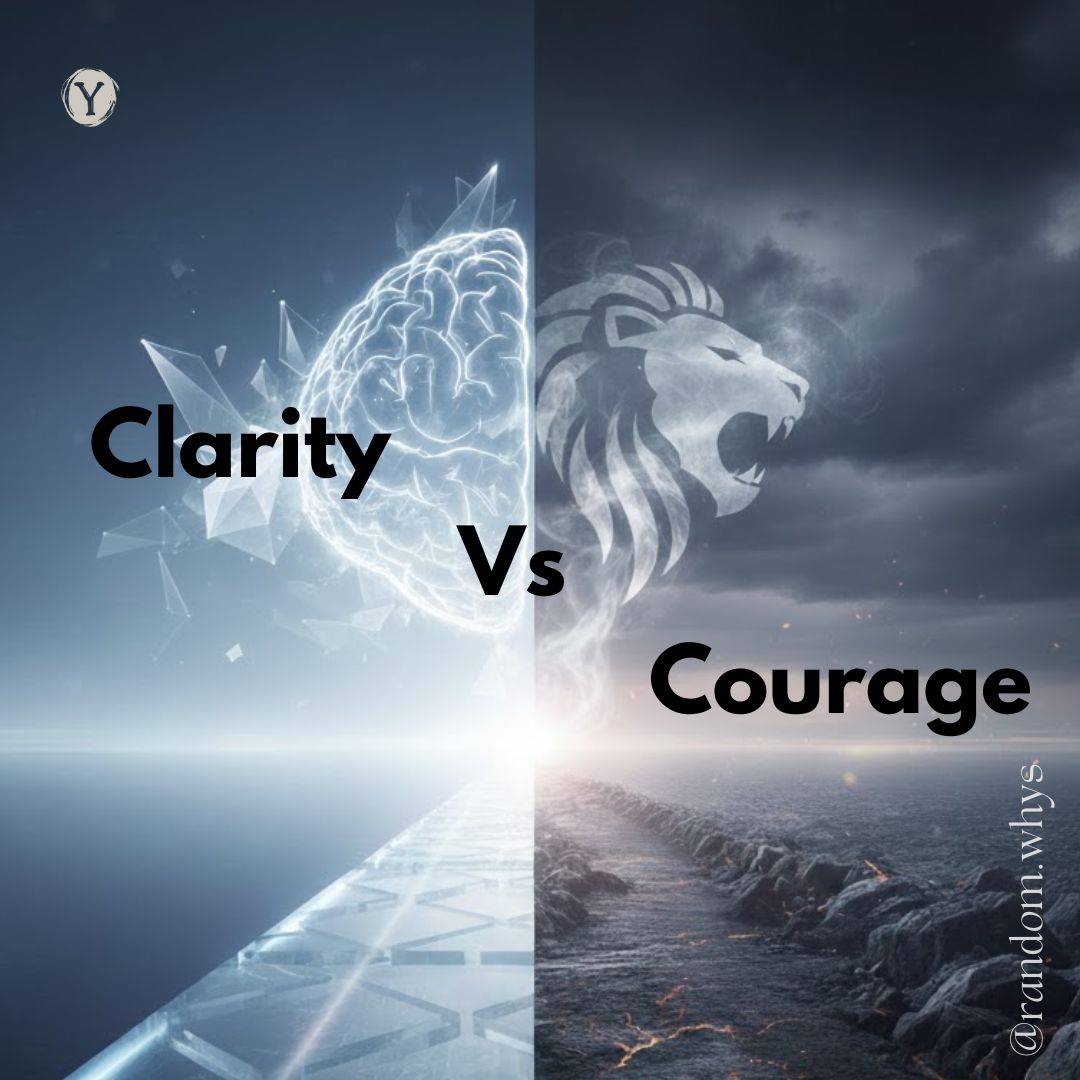
Clarity vs Courage!

2–3 minutes

It is what it is. Such an ordinary line. Yet it holds a whole philosophy inside it especially when we are standing at the edge of something big, like starting a business or making a life-shifting decision.

For the last few days, I’ve been thinking about this question: Do we need clarity first, or courage first? And the more I observe my own decisions, the more this tension shows up everywhere.

J. Krishnamurti had a very sharp view on this. He said that when you truly see something as it is without fear, without illusions, without desire distorting your view the right action just happens. No force. No push. No be brave quotes.

Clarity is not romantically, emotionally, with prejudice, with what you would liked it to be. It is the effort to see things absolutely as they are in daily life. And when there’s clarity there’s no need for exercise of will or choice. Someone can live in daily life without any kind of will, choice and resistance.

Clarity as the state where fear (which necessitates courage) and confusion (which necessitates choice/will) are both absent. You simply act because the path is obvious. The mind becomes so clean that action feels like a natural consequence, not a choice. A luxury most of us don’t have on a daily basis.

The moment you step into building something a business, a product, even a small side project this clean philosophical world breaks. Life, work, and entrepreneurship pull us in too many directions. Here, clarity and courage are constantly fighting for attention.

When clarity matters

Clarity is where you understand the basics. The problem you want to solve, who you’re solving it for, and the simplest place to start. Without this grounding, your effort gets scattered. Clarity keeps you from running blindly and wasting time on things that don’t matter.

When courage matters

Even with clarity, you still have to act and that’s where courage steps in. Building anything new comes with uncertainty, rejection, and risk. Courage is what makes you take the first step, share your rough work, and keep going when things get uncomfortable.

Balance

Clarity and courage don’t follow a sequence or an order. They reinforce each other. You get clear enough to begin, then use courage to take a step. That step gives you new information, which sharpens your clarity. With that clarity, you take the next courageous step. It’s a loop, not a linear path. Each one feeds the other as you move forward.

Perfect clarity is rare, and waiting for it only delays your life. Real progress comes from a mix. Enough clarity to know your direction, and enough courage to actually move. The path reveals itself only after you start walking.

Cheers!

Check out the previous post: Where Art Lives?

Follow on IG X for more!

If you like what you see and wish to support my work, then

Share your thoughts/suggestion at the comment section or mail at

randomwhyss[@]gmail[dot]com

Don’t miss out! Get notified about new blog posts straight to your inbox !

(No spam, pinky promise!)

Enter your mail to receive updates

Where Art Lives? Between Intention and Interpretation

3–5 minutes

I was watching Mona Lisa Smile last night, there is a struggle between the rigid structure and a progressive teacher. The students, trained in art history, view art as a checklist. They measure greatness by technique, historical significance, and academic consensus.

But the teacher (Katherine), asks them to stop thinking and just look. This raises the same question we spiral into, Is art objective (a science) or subjective (a feeling)? I have written few pieces on how it is subjective, but diving into different perspective today.

The Objectivity

Let’s start with a question. Is a toddler’s drawing of a cat or my own oil pastel tulips (forgive me) worse than Van Gogh’s Starry Night?

Technically? Maybe. But emotionally? To a stranger, the toddler’s drawing is scratch marks. To the toddler’s mother that drawing might evoke a deeper emotional response than any Van Gogh ever could. The value of the art changes entirely based on who is looking at it.

Van Gogh isn’t objectively better. Van Gogh is just intersubjectively validated. Intersubjective means that millions of us have agreed that his work carries meaning. We have built a consensus. But consensus is not the same thing as objective truth. It’s just a shared opinion.

Where Philosophy meets Biology

If art is subjective, why do 99% of humans agree that a tulips are beautiful? Fine, let’s take rose as an example. I recently found myself debating the ghost of the philosopher George Berkeley. Berkeley famously argued that “to be is to be perceived.” He might argue that the rose is beautiful to all of us because we are all tuning into a universal broadcast (God/universe).

  • Symmetry = health in nature.
  • Vibrant Red = ripe fruit and survival to our primate brains

This universal beauty isn’t art. it’s instinct/programming/conditioning. Agreeing that a rose is pretty doesn’t make us art critics. It just makes us human. If an alien species evolved on a planet where red meant poison and symmetry meant predator, they would look at our rose and recoil in horror. The rose isn’t objectively beautiful. It’s only beautiful to us.

But what if I paint a burning rose? Or a decaying rose Or a black rose ?

  • One viewer might see the burning rose as a symbol of passion.
  • Another might see it as a symbol of destruction and climate change.
  • A third might see it as liberation from tradition.

The rose hasn’t changed. The viewer has brought your own life, your own experiences, and your own hope to the canvas.

The Gap: Where Art Actually Lives

If there is no objective standard, does art lose its meaning? On the contrary. It gains it.

  • The Encoding: The artist feels something (grief, rage, hope) and tries to lock that feeling into a physical object (paint, clay, sound).
  • The Gap: The object sits there, silent.
  • The Decoding: You, the viewer, look at the object. You unlock it using your own life keys of experiences, trauma, joy, culture and more.

Art lives in the gap. It lives in the space between what the artist intended and what you perceive. The artist provides the prompt; you provide the meaning.

Intersubjective Space

The burning rose works because of shared cultural knowledge.

  • Rose = beauty/romance (cultural agreement, not biological fact)
  • Fire = destruction/passion (agreed symbolism)
  • Paint on canvas = Art (consensus that this deserves attention)

This is consensus reality. It’s not true because of physics; it’s true because we’re all telling the same story together. Art needs both the shared language (intersubjective) and your personal translation (subjective).

The Knowledge Paradox

Knowledge doesn’t make art objective, but it makes your subjectivity richer. If you look at a painting knowing nothing, you feel something. If you look at a painting knowing the history, the symbolism, and the artist’s life, you feel more.

The Art is Subjective. The emotional impact of the “why” is entirely up to the us. The artist can only create the bridge. They use their skills to encode an emotion into an object.

Katherine was right. You can learn everything about the paint, the canvas, and the date it was made. But until you decide how it makes you feel, you haven’t actually seen the art. You’ve only seen the object.

There is no single answer in art. There is only the artist’s intention and your interpretation and the art lives in the space between them.

Cheers

PS: Not sure if I made sense

Check out the previous post: Paradox of Growth and Stability

Follow on IG X for more!

If you like what you see and wish to support my work, then

Share your thoughts/suggestion at the comment section or mail at

randomwhyss[@]gmail[dot]com

Don’t miss out! Get notified about new blog posts straight to your inbox !

(No spam, pinky promise!)

Enter your mail to receive updates

Paradox of Growth and Stability

2–3 minutes

For the last few days, I’ve been stuck on a paradox that feels central to life right now. The tension between growth and stability. Earlier, my confusion was about growth versus solitude. That was simpler. Solitude is a condition, you can enter or exit it. But this one is harder. This one sits at the core of how life actually moves.

Some part of us always craves growth, new skills, new versions of ourselves, new territories to explore. Transformation has its own high. But everything we call “growth” comes with a cost, and that cost is almost always stability.

Growth demands motion. Stability demands stillness. And the human mind wants both.

I’ve been trying to understand whether this tension maps to the idea of maximizers vs. satisfiers. Maybe it does, maybe it doesn’t. The distinction isn’t helping me reach a conclusion. What I can see clearly is this, when your soul craves growth, stability becomes a by-product. You get it only after a phase shift, never during it.

Stability isn’t the companion of growth, it’s the outcome of a growth cycle. You build, you stretch, you break patterns, you endure discomfort, and then you land. That “landing” feels like stability, but it is temporary. Because after some time, the soul asks again, What’s next?

So the question isn’t “Can we blend growth and stability?” The question is Which phase are we in? Cocoon or the butterfly?

If the soul is restless, chasing stability is pointless. If the soul is tired, forcing growth is counterproductive.

Maybe the real skill is learning to switch, knowing when to step into expansion and when to sit inside equilibrium. Not trying to merge them into one perfect formula, but letting life run in cycles. Because growth is movement. Stability is the pause. Both are necessary but not at the same time.

How do you see and handle this ?

Cheers

Check out the previous post: Perspective Shift!

Follow on IG X for more!

If you like what you see and wish to support my work, then

Share your thoughts/suggestion at the comment section or mail at

randomwhyss[@]gmail[dot]com

Don’t miss out! Get notified about new blog posts straight to your inbox !

(No spam, pinky promise!)

Enter your mail to receive updates

Perspective Shift!

1–2 minutes

We often get stuck because we keep looking at a situation from only one angle. When a problem refuses to move, it’s usually not the problem but it’s our perspective. A single viewpoint creates a loop. We keep circling the same thoughts and eventually confuse repetition for clarity.

The way out is simple is to shift the angle/view point.

A different lens can reveal a detail we missed, a pattern we didn’t notice, or an option we never considered. And if you can’t find that shift on your own, borrow someone else’s eyes. A close friend or family member can often spot in seconds what we overlook for weeks.

It’s a lot easier to say than to practice. Change doesn’t need force, it needs a different viewpoint.

Cheers

Check out the previous post: Systems

Follow on IG X for more!

If you like what you see and wish to support my work, then

Share your thoughts/suggestion at the comment section or mail at

randomwhyss[@]gmail[dot]com

Don’t miss out! Get notified about new blog posts straight to your inbox !

(No spam, pinky promise!)

Enter your mail to receive updates

Systems

1–2 minutes

Finding a good habit in the middle of social noise is harder than it looks. Everyone wants a routine that fits neatly into daily life, but routines are fragile. A short trip, a movie or a late event, or an unexpected change is enough to break weeks of stability. And once a routine breaks, getting back into it always requires force (Trust me!) . A restart, a push, a negotiation with yourself for long hours or even days.

Routines work only when the conditions around them stay perfect. Life rarely does, it pulls sideways. This is why long-term consistency depends not on routines but on systems. A system is the underlying design that supports your behaviour, the environment, less friction, strong boundaries, and the backups you build. Systems reduce the need for motivation by making the desired behaviour the path of least resistance.

That consistency is not a product of perfect daily routines, but the result of a well-designed system that carries you even when life gets unpredictable.

The goal isn’t to perform habits flawlessly, it’s to design a life where good habits survive interruptions and return on their own.

Cheers!

Check out the previous post: The Metaphor

Follow on IG X for more!

If you like what you see and wish to support my work, then

Share your thoughts/suggestion at the comment section or mail at

randomwhyss[@]gmail[dot]com

Don’t miss out! Get notified about new blog posts straight to your inbox !

(No spam, pinky promise!)

Enter your mail to receive updates

The Metaphor

1–2 minutes

Two years ago, I bought a flip flop. Simple, and comfortable. It fit into almost everything I wore and felt easy to walk in. For a while, it was my go to choice.

But comfort has a way of disguising friction. If you walk too long in the wrong fit, it doesn’t hurt immediately, it dulls your awareness first. This one didn’t tear, my skin did. The material stayed strong, while my legs slowly adjusted to the pain until they couldn’t anymore.

That’s how attachment often works. You stop questioning what you’ve adapted to, mistaking endurance for stability. You only realize the damage when it begins to limit your movement.

Sometimes, the hardest part isn’t letting go but in recognizing what’s quietly hurting you while still appearing functional.

Decluttering isn’t an act of loss. It’s a return to alignment. The flip flop was fine. It just wasn’t right anymore.

Cheers!

Check out the previous post: Do tulips know they’re red?

Follow on IG X for more!

If you like what you see and wish to support my work, then

Share your thoughts/suggestion at the comment section or mail at

randomwhyss[@]gmail[dot]com

Don’t miss out! Get notified about new blog posts straight to your inbox !

(No spam, pinky promise!)

Enter your mail to receive updates

Do tulips know they’re red?

1–2 minutes

I was blending oil pastels yesterday watching colors turn into new colors I didn’t expect. Something about that transformation felt pure. Like beauty appearing out of nothing. it felt nice.

Then the book I’m reading (Three Dialogues between Hylas and Philonous) messed with my peace.

It argued that color doesn’t exist outside the mind. Shape doesn’t either. Not even the tulip we’re so sure is real. What we see is the brain’s version of reality…not reality itself.

I looked at my sketch again. Was the beauty on the paper? Or inside me?

Neuroscience agrees with the philosophers: the world doesn’t arrive fully formed. The brain builds it light into color, vibration into sound, memory into meaning. We think we’re observing the world. Really, we’re constructing it.

Perception is a controlled hallucination – Anil seth

And yet, almost everyone finds a rose beautiful. Maybe because life taught us to notice color that meant food, symmetry that meant safety, softness that meant care. Maybe what we call “beautiful” is evolution and emotion agreeing on the same picture.

The strange part? The brain is both the creator and the admirer, designing the illusion and then falling for it. A blank page becomes a world, if the mind decides so.

Maybe reality isn’t something we find. Maybe it’s something we make color by color, meaning by meaning, right inside the head that wonders about it.

So… what is a tulip’s color really then?

Cheers

PS: Tulips from my collection of pastels

Check out the previous post: Passionate about other People’s Passion!

Follow on IG X for more!

If you like what you see and wish to support my work, then

Share your thoughts/suggestion at the comment section or mail at

randomwhyss[@]gmail[dot]com

Don’t miss out! Get notified about new blog posts straight to your inbox !

(No spam, pinky promise!)

Enter your mail to receive updates

Passionate about other People’s Passion!

1–2 minutes

Recently, I’ve heard people say they’re passionate about other people’s passion. At first, I assumed it was just another form of mimetic desire, wanting what others want. But it’s not. It’s something subtler.

We are always been drawn to people who come alive when they talk about what they love, the way their eyes shift, their tone deepens, their whole body syncs to that one thing. You can feel their pulse in their words.

It’s not that I want to do what they do. It’s that I’m fascinated by the flow state they’re in. That flow where time dissolves, where they merge with what they’re doing. That aliveness is magnetic.

What draws us isn’t their craft. It’s the clarity that comes when purpose and presence align. It reminds you that somewhere within us, we also have something that could make us feel that alive.

Being passionate about other people’s passion isn’t imitation. It’s resonance. You’re not chasing their path but you’re remembering your own capacity for depth.

Let others’ passions remind you that aliveness is contagious, not competitive.

Cheers

Check out the previous post: Stillness and the Void!

Follow on IG X for more!

If you like what you see and wish to support my work, then

Share your thoughts/suggestion at the comment section or mail at

randomwhyss[@]gmail[dot]com

Don’t miss out! Get notified about new blog posts straight to your inbox !

(No spam, pinky promise!)

Enter your mail to receive updates

Stillness and the Void!

2–3 minutes

Yesterday, I found myself in a long conversation about everything career, money, love, success, failure, marriage, children, routines, health, rest and what not. Somewhere between all those words, I realized how much of life we build to escape something deeper, the quiet space inside us that has no clear/definite answer.

Maybe all these pursuits are ways to keep ourselves entertained, to avoid the weight of that silence/void within us. We chase goals, ideas, people, and meanings not because they will complete us, but because they keep the void at bay.

The irony is, our brain feels rewarded not when it finds the answer, but when it searches for one. We are wired to seek, not to rest. The mind keeps running, chasing afraid that if it stops, it will disappear into nothingness/abyss.

But what if that nothingness isn’t as empty as it seems?

The more I observed, the more I felt that self-awareness is not an escape from the void. It’s a doorway into it. You begin to notice how your mind rushes to fill every silence. Be it with people, work or hobbies. Awareness doesn’t instantly bring peace; it just shows you the mechanism. Yet, once you see it, you can’t unsee it.

Stillness, I think, is what happens when you stop fighting that void. It’s not about silencing your thoughts or meditating endlessly or giving up curiosity. it’s about allowing the silence to exist without fear. The void remains, but your resistance softens.

And then something shifts. The same space that once felt unbearable begins to feel light. The emptiness turns into a kind of quiet peace.

When the self stops searching for peace, the absence of that search is peace.

The void becomes peace not because it changes, but because you do. When you stop naming it, judging it, or running from it, what’s left is stillness itself.

Maybe that’s what it means to really know yourself . To become intimate with the void, and to find that peace was never outside of it.

Cheers

Check out the previous post: The Duality of Being!

Follow on IG X for more!

If you like what you see and wish to support my work, then

Share your thoughts/suggestion at the comment section or mail at

randomwhyss[@]gmail[dot]com

Don’t miss out! Get notified about new blog posts straight to your inbox !

(No spam, pinky promise!)

Enter your mail to receive updates

The Duality of Being!

1–2 minutes

With the rise of the digital world, staying rooted in the physical one takes intention and effort.

I am trying to follow a simple rule. Limit my internet use. My phone plan runs for three months with limited data. What began as a cost-effective choice slowly turned into a conscious practice. So, when I go out, limited data makes me pause before every click and it filters what truly matters from what’s just noise.

Still, it’s not easy. The internet is stitched into everything. For eg, Google Maps, Strava, UPI, Rapido or even WhatsApp. Even a simple SMS feels like a relic as it exists only for OTPs. I’ve tried cutting digital clues with wallpaper, minimal apps, fewer notifications but complete detachment isn’t realistic. Some days, I am bounded to recharge a one-day data pack and get back online, just to finish something that can’t stay offline.

That’s why I began reaching for hobbies that don’t need gadgets like oil pastels, real books, small hands-on things and trying to meet friends. They remind me that presence has texture/emotion. Still, even they demand a trace of the internet. To share a piece of work, or simply exist in the loop. It can’t be fully avoided.

It’s not exactly friction that the internet creates, but something subtler, a quiet thing with how I experience the world around me. It lowers my in person effectiveness, my ability to stay rooted in what’s real and immediate.

I keep wondering if it’s just me. Or if we’re all, in our own ways, trying to rebuild a life that can balance between being connected and being present.

Cheers!

Check out the previous post: You Have Nothing to Prove!

Follow on IG X for more!

If you like what you see and wish to support my work, then

Share your thoughts/suggestion at the comment section or mail at

randomwhyss[@]gmail[dot]com

Don’t miss out! Get notified about new blog posts straight to your inbox !

(No spam, pinky promise!)

Enter your mail to receive updates

You Have Nothing to Prove!

1–2 minutes

It might sound absurd, but it’s true. You have nothing to prove to anyone. Not your parents. Not your friends or enemies. Not the people who doubted you.

Every time you do something just to show you’re worthy, you subtly agree with the belief that you weren’t enough to begin with. That’s the trap.

Of course, your role as a parent, a professional, a partner, or a friend demand effort, work, performances and accountability. But effort given from alignment feels different from effort driven by validation. One expands you, the latter exhausts you.

There’s a quote that says,

Don’t become what you hate.


And that’s what proving does, it quietly turns you into the very person whose approval you once craved.

The path forward isn’t to stop caring. It’s to care differently. Do the work because it feels right. Build because it fulfills you. Not to silence doubt but because you no longer need to.

Learn to pause between the stimulus and your response, that brief silence is where power lies. The day your actions stop being reactions, you’re finally free.

Cheers!

PS: maybe to self (that’s a bigger and never ending trap, lol)

Check out the previous post: Follow Your Plan, Not Your Mood! & Dude Movie Review

Follow on IG X for more!

If you like what you see and wish to support my work, then

Share your thoughts/suggestion at the comment section or mail at

randomwhyss[@]gmail[dot]com

Don’t miss out! Get notified about new blog posts straight to your inbox !

(No spam, pinky promise!)

Enter your mail to receive updates

Dude (2025) Movie Review

2–3 minutes

Full of spoilers ! Don’t read before watching!

This movie might not be everyone’s cup of tea. Many might even dismiss such stories as unrealistic. But that’s exactly where it surprises you by taking a sensitive topic like honor killing (always reminded of V1) and turning it into something comical yet thoughtful.

Without revealing much of the concept, I’d say the film’s strength lies in its tone. It handles rituals, customs, and deeply ingrained social issues with a mix of satire and sensitivity. PR, Mamitha, and Sarath absolutely carried the show, while the others including Hridh (Parri) had minimal but fitting and impactful roles.

However, the issue is that while the movie lands several strong plot twists, and points, each is immediately followed by laughter leaving little time for reflection. The idea gets registered, but it doesn’t linger.

Still, here are some of the key scene that stood out for me

  1. A girl can say no and that “no” deserves respect without needing justification.
  2. Even a girl can have a confusion in her mind about her choices.
  3. The thali is just a ritual emotions define love, not symbols.
  4. Single parents (mothers) are often judged unfairly for their parenting choices.
  5. Caste remains an undercurrent, even when people think they’ve moved past it.
  6. Some viewers felt Paari’s role lacked depth, but giving him more weight would’ve shifted focus away from the central theme. If you look keenly, he carries more depth. No men would let other men marry their loved ones even in terms of survival.
  7. True love thrives only with an abundance mindset both must be and can be happy.
  8. Life matters more than caste, pride, or honor.
  9. Sometimes it’s just about meeting the right people at the right time.
  10. Can people really be this selfless? Maybe if they’re Shahjahan Pro Max, egofree.
  11. Certain scenes especially where Mamitha takes the lead show that even in a male-dominated setup, the hero should be the scapegoat for her choice. That might not please everyone, but it’s honest. And he was willing (might not sound realistic)
  12. I am not sure of Paari’s character in real life. Toughest of all male characters written. It reminds me of the Past lives movie (Husband’s role). Obviously, it’s just cinema.

The film subtly highlights privilege that freedom of choice, voice, and safety aren’t available to everyone. Some scenes might feel unrealistic or idealistic, but perhaps that’s the point, to imagine a world where women  ( irrespective of gender) can choose love without fear. Maybe, it’s all about survival?

It’s a bold experiment but lighthearted, layered, and far from perfect. Songs were good but background scores could have been better. Give it try! Atleast you will laugh!

Cheers!

Happy Dilwali !!!!

Check out the previous post: Follow Your Plan, Not Your Mood! & Movie Reviews

Follow on IG X for more!

If you like what you see and wish to support my work, then

Share your thoughts/suggestion at the comment section or mail at

randomwhyss[@]gmail[dot]com

Don’t miss out! Get notified about new blog posts straight to your inbox !

(No spam, pinky promise!)

Enter your mail to receive updates

Follow Your Plan, Not Your Mood!

1–2 minutes

There’s a quote I once came across that caught my attention few days yet I ignored.

Follow your plan, not your mood.

The truth is, I never really managed to internalize it fully. It’s easy to understand but hard to practice. Following a plan, especially when emotions pull you in different directions, requires willpower or sometimes, a strong reason that reminds you why you started.

There are no playbooks or shortcuts to switch off emotions and instantly operate from your logical brain. It takes conscious effort.

What has worked for me, though, is keeping the end point/result in mind, the satisfaction of seeing the work completed. Sometimes, even creating a little fear of missing out if I don’t stick to the plan helps. It’s a mental nudge that keeps me from drifting.

Over time, this practice slowly builds into a habit. It creates a quiet sense of self-awareness the kind that reminds you that discipline often begins where motivation fades.

Try experimenting with this mindset and see how it works for you.

Cheers

Check out the previous post: What is the Purpose of Life?

Follow on IG X for more!

If you like what you see and wish to support my work, then

Share your thoughts/suggestion at the comment section or mail at

randomwhyss[@]gmail[dot]com

Don’t miss out! Get notified about new blog posts straight to your inbox !

(No spam, pinky promise!)

Enter your mail to receive updates

What is the Purpose of Life?

1–2 minutes

It’s one of the most philosophical questions and no matter what age you are, at some point, it catches up with you! What is the purpose of life?

Some tie their purpose to fame, money, or possessions/wealth. For a while, these can feel fulfilling but eventually, they reveal their ends. The more you have, the more you want. Contentment stays just one step ahead, always out of reach.

Over time, through people I’ve met (virtual and inperson) and books I’ve read, one thought was same across. The true purpose of life is to be useful to others. To make someone’s life a little lighter, better, or more hopeful, that’s where satisfaction lives.

It doesn’t have to be something grand. It could be through an act of service, sharing what you know, offering support, or even a bit of help when someone needs it. When you follow that small itch to be useful to contribute in some way, it quietly shapes your path.

Maybe that’s what purpose really is not a single grand answer, but a daily act of giving meaning to your existence through others, if it matters to you.

Of course, it’s a selfish act. Because in helping others, we help ourselves feel whole.

Cheers!

Check out the previous post: Consistency Over Perfection!

Follow on IG X for more!

If you like what you see and wish to support my work, then

Share your thoughts/suggestion at the comment section or mail at

randomwhyss[@]gmail[dot]com

Don’t miss out! Get notified about new blog posts straight to your inbox !

(No spam, pinky promise!)

Enter your mail to receive updates

Consistency Over Perfection!

1–2 minutes

Last week, I wrote about randomness and organization how organization always creeps in before randomness even gets a chance to breathe. I’ve been thinking about how this pattern repeats in another pair too! consistency and perfection.

The need for perfection always walks in first, dressed up and confident, and quietly kills the very thing that could have kept the process alive consistency.

I used to walk before just for the sake of it. No numbers, no metrics, no pressure. But the moment I started tracking every calorie and step, I began forcing myself into perfection. It’s strange how quickly a joyful activity can turn into a performance review.

Protecting the goose is more important than chasing the golden egg. Consistency is the goose. Perfection may promise shiny outcomes, but without the quiet, steady act of showing up, there’s nothing left to perfect.

This holds true for anything work, relationships, habits. You have to show up before you optimize.

Cheers!

Check out the previous post: #DecodeAgri19: Why agri graduates lag?

Follow on IG X for more!

If you like what you see and wish to support my work, then

Share your thoughts/suggestion at the comment section or mail at

randomwhyss[@]gmail[dot]com

Don’t miss out! Get notified about new blog posts straight to your inbox !

(No spam, pinky promise!)

Enter your mail to receive updates