Glimmering Serenity!

3–4 minutes

Life’s unpredictability is what makes it a fascinating journey, filled with unexpected twists and turns. As we journey through our lives, it becomes increasingly evident that not every day will be a masterpiece. Some days are just average, while others seem to be downright challenging. There are days when you yearn for the simplicity of a carefree existence, akin to a dog, a cat, or even a cow grazing peacefully on the grass. On some occasions, you find yourself simply counting down the hours, waiting for the day to come to a close.

Yet, amidst this rollercoaster of experiences, there are those days that feel like you’re floating on cloud nine, days when life seems like a captivating story, and days when you can’t help but feel proud to be part of the human race. There is no foolproof formula or crystal ball that can predict how each day will unfold. You may have preconceived notions about how it will play out, but reality often surprises us with its beauty or challenges.

I used to be incredibly naive and innocent, believing that the days ahead would always be filled with unending happiness. However, as reality sets in, you come to realize that true happiness may only grace you for a few minutes or perhaps a bit longer during the day. One of my all-time favorite KDramas, “Liberation Notes” (a slice of life), features a poignant moment when the lead character shares,

A men and women having a conservation at the table

In the past, I had the impression that she wasn’t experiencing much happiness, possibly due to the challenges of her work, and I couldn’t help but find it amusing. However, with time, I came to understand that these little moments that bring us joy are the very essence of what makes each of us and our days unique.

During my journey of figuring things out, I stumbled upon something pretty cool—the way our brains work, especially with this thing called dopamine. Learning about this not only helped me make sense of why our moods can be all over the place but also why even on really hard days, there can be moments that make us unexpectedly happy.

I’m an avid listener, especially when it comes to individuals like Dr. Andrew Huberman. He’s an outstanding expert who generously shares his profound insights on a wide range of topics, including neurology, the brain, sleep, hormones, etc. I remember tuning in to one of his podcasts dedicated to the intricate world of dopamine.

When something enjoyable happens, like having a delicious meal or winning a game, your brain releases dopamine, which makes you feel happy and motivated. But here’s the catch: after this burst of happiness, your brain needs to return to its normal mood level, like a seesaw going back to a balanced position. This return to normal is what we call the “dopamine crash. It’s when you might feel a bit down or less excited after the fun experience ends.

This is entirely normal and happens because our brains are designed to maintain balance. Over time, if we have too many intense “ups” with lots of dopamine, our brain can get used to it, and we might need even more excitement to feel the same happiness. So, remember, ups and downs are a part of life, and our brains are pretty good at handling them.
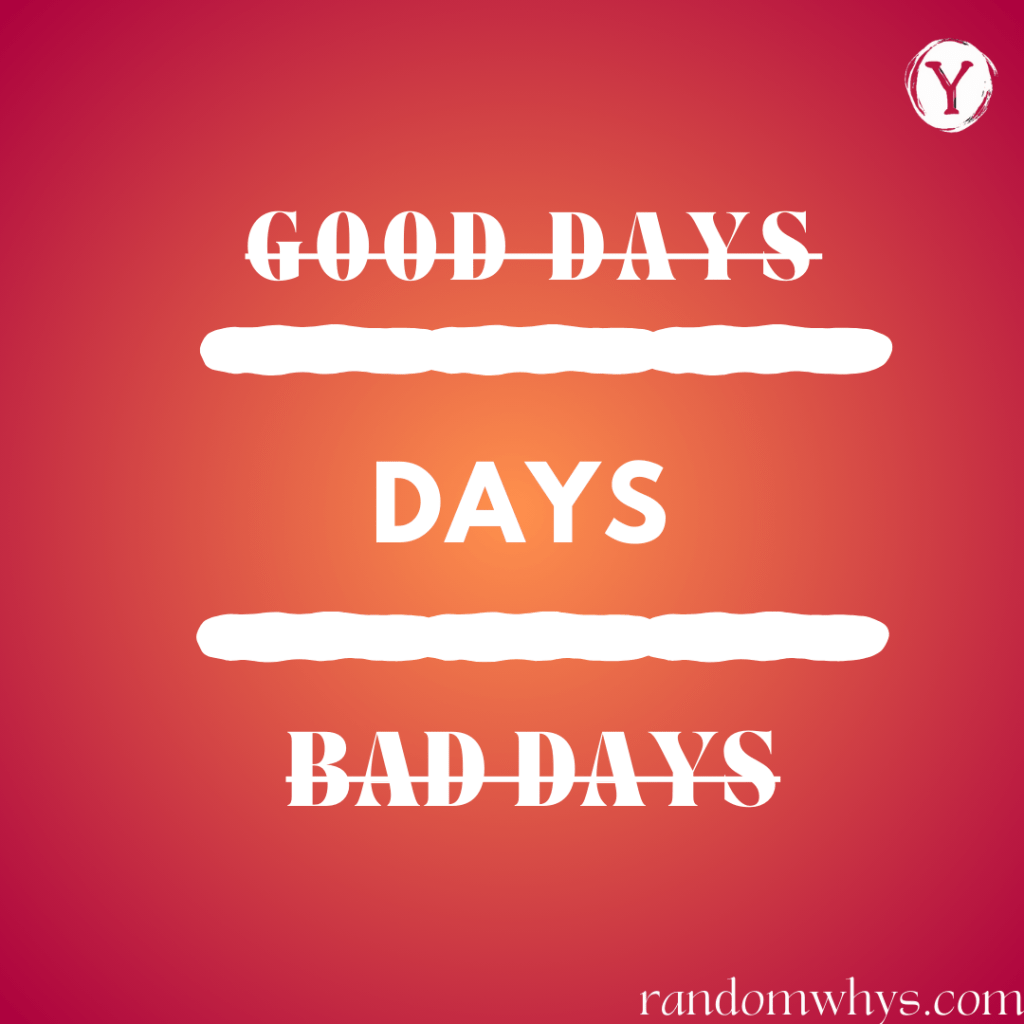
There are no good or bad days, just days

After listening those podcast and reading stuff, I had a bit of a moment that explained why sometimes, after a truly shitty day (yes, the kind that makes you laugh), I end up feeling surprisingly good. It turns out our emotions are quite a puppet show, orchestrated by some brain chemicals like dopamine, serotonin, cortisol, etc. These days, I’ve ditched the habit of labeling them as “good” or “bad. Instead, I see them as just… well, days. No judgments, no labels—just days, plain and simple.

I’m wrapping up this article with a beautiful Tamil verse by Yathiri, and the highlighted word adds up to the original one.

எல்லா நாட்களுக்கும் (உறவுக்கும்) ஏதாவது பெயர் வைத்தே ஆகவேண்டுமா என்ன ? 
சும்மா விடேன். 
அதன்போக்கில் இருந்துவிட்டுப்  போகட்டும்.

-யாத்திரி  

Cheers!

PS: Experimenting with Color palette & Gradients

I do send out my posts to very few people. Join my mailing list if you enjoy what you read.

Boundless Choices!

3–5 minutes

The word choice comes from the old French word chois, meaning selection or option. Choices are the fundamental building blocks that shape our lives, define our paths, and determine our destinies. At every juncture in life, we are confronted with choices—choices about our education, careers, relationships, beliefs, and actions. These decisions encapsulate our desires, values, fears, and aspirations, revealing our true selves to the world and, perhaps more significantly, to ourselves.

It seems like a piece of cake, right? You’ve got a bunch of options, and you just need to pick one. That’s what I used to believe, too. Choosing seems like a no-brainer because, hey, you’ve got choices. All you need to do is list the good stuff and the not-so-good stuff, and voila, you’ve made a decision. I was in that boat too, once upon a time.

Kunal Shah‘s Q&A sessions really got my brain gears turning; they were like a feast of fresh perspectives. His insights were like a breath of fresh air, shaking up my usual way of thinking. I remember one question he tackled about success (I can’t recall the exact words). What caught my attention was how he tied his answers back to the whole concept of choices. I couldn’t help but crack a smile as I read through his responses before getting back to my everyday tasks.

After that, it seemed like everywhere I looked, I started noticing how choices played a mammoth role in the whole success game, and honestly, in pretty much everything. Let me spell it out a bit.

Picture this: There’s a student who’s super keen on studying abroad. Now, there are a ton of universities spread out across different continents, all with different things to offer. So, our student has to consider things like what they want to study, where they want to live, how much it’s going to cost, if there are any scholarships, and also what’s up with family finances. Having all these choices can give them the power to pick a path that sets them on the right track towards their goals.

The job market works the same way. For someone on the hunt for a job, having lots of choices in terms of what they could do, where they could work, and how much they could make can be a real game-changer. They can think about things like salary, benefits, how they’ll fit into the company vibe, and where they could go from there before they decide.

But here’s the twist: not everyone has this luxury of tons of choices. Some folks might be stuck in situations where they can’t see all those options clearly—maybe because of money stuff, not getting the right information, or other roadblocks. So, you see, not everyone’s playing on the same field when it comes to choosing.

Alright, let’s dive into another scenario: credit cards. Back in the day, I was all like, “No way, credit cards mean debt. But boy, was I in for a surprise. Once you peel back the layers and check out all those perks and cool stuff you can get with these cards, it’s like stepping into a whole new world.

But hold up a sec. Not everyone has the same ticket to this credit card party, especially here in India. It’s not like everyone can just waltz in and grab a credit card with all those perks. Nah, it’s a bit more complicated than that.

You see, getting your hands on one of these cards means you’ve got to have a solid credit score, a steady paycheck, and some proper proof of your income tax returns. It’s like this secret code that says, Hey, I’m financially responsible enough to handle this. (Lol)

You got it, the same dance happens when it comes to building wealth. These choices? Speaking of which, there’s this incredible podcast episode in the “Diary of a CEO” series, featuring a professor named Scott Galloway. Specifically, he shed light on how a scarcity of potential female partners can alter the game.

Having lots of choices lets us really think things through, which helps us chase our dreams. But here’s the thing: not everyone gets the same chances, which makes success uneven. Whether it’s about school or jobs, each choice matters a lot. And we need to remember that not everyone has the same pile of choices to pick from.

But the cool part? We can help level the playing field by creating equal opportunities and understanding each other’s journeys. By doing that, we’re not just shaping our own success but also making the road smoother for everyone else aiming for their dreams. So, let’s remember that not only do we choose our paths, but we also have the power to create choices for those who might not have them readily available.

Cheers!

I do send out my posts to very few people. Join my mailing list if you enjoy what you read.

How Movies Opened My World!

The pandemic led me to explore diverse movies, expanding my cultural and emotional horizons. From Hollywood to Indian, French, and Korean films, the experience broadened my understanding and offered solace.

5–7 minutes
Photo by Tyson Moultrie on Unsplash

Before all the pandemic stuff, I wasn’t really into movies. Yeah, I’d hit up the movie theater every now and then, catch a flick—you know the drill. But who would’ve thought that this whole movie thing would turn into a whole new adventure for me? It’s like I stumbled upon a treasure chest of storytelling that I never really paid attention to before.

Back in the good ol’ days before COVID took over, my movie journey was pretty much Tamil, Malayalam, a few Hindi, and English movies—that’s about it. I wasn’t really digging too deep into the movie world, just dipping my toes here and there.

Then came the pandemic, and there I was, chilling in my little place with not much to do. I started watching those fun reality shows from way back when, you know, the ones that give you a good laugh. But then a buddy of mine swoops in with some movie recommendations, like “Badhaai Ho,” “Chhichhore,” “Dia,” “Dream Girl,” “The Girl Next Door,” and even some classics that were older than my grandma. I’m thinking, “Alright, let’s give these a shot.

And holy smokes, that’s when the whole game changed. Suddenly, I’m not just watching these movies; I’m diving headfirst into their worlds. I’m paying attention to the plot twists, the cool dialogues, the music that hits you right in the heart, and those scenes that make you feel like you’re right there with the characters. It’s like I’m on a movie marathon, binge-watching like there’s no tomorrow.

What’s crazy is how these movies were totally different from the usual stuff I’d seen before. They had these wild storylines that took me to places I never even imagined. It was like peeking through a secret door into a whole new universe that I never knew existed.

I’m not exactly a global movie buff, but I’ve got a taste for Hollywood, Indian, French, Chinese, Thai, and even Korean and Japanese films. And let me tell you, it’s like a burst of happiness hit me when I started exploring movies from all these different corners of the world. It’s like a shot of dopamine for my curiosity.

It’s really cool how some movies take you into completely different cultures. Just imagine: the main character decides to move to a new place, and all of a sudden, you’re right there experiencing the vibe and way of life of that place. Think about movies like “Into the Wild,” “Emily in Paris,” “Perfect Pairing,” “Queen,” “Falling Inn Love,” and a bunch of others (you know, the ones that are almost at the tip of your tongue but not quite). It’s like finding a hidden treasure chest filled with all kinds of different cultures and exciting stories.

Certain movies have played a crucial role in shattering stereotypes, while others have bravely tackled taboo subjects. I’ve come across films that opened my eyes to the fact that some issues aren’t as monumental as they might seem, urging me to view them from a different angle. Titles like “Sex Education,” “Sky Castle,” “Aruvi,” “Piku,” “Super Deluxe,” and “Modern Love” have been particularly impactful in this regard.

Several movies have played a significant role in deepening my understanding of trauma and addressing societal issues. Films like “Beef,” “Tamasha,” “Dear Zindagi,” “The Great Hypnotist,” “Kill Me, Heal Me,” “It’s Okay to Not Be Okay,” and “It’s Okay, That’s Love” have been powerful tools in shedding light on these important subjects.

There were instances when I experienced deep emotional lows, causing me to question whether I was the only person undergoing such hardships in the world. During these contemplative moments, specific series such as “My Mister,” “Liberation Notes,” and the impactful film “Parasite” emerged as sources of solace. Collectively, these narratives illuminated the fact that although my struggles were deeply personal, they were not singular, thus dispelling my feelings of isolation and reaffirming a profound connection to the broader human experience.

Back in the day, I’ll admit I was a bit naive. But you know what they say – life isn’t just rainbows and sunshine. It was these shows that truly opened my eyes to the shades of gray in people’s characters. From the glitzy world of “Celebrity” to the intriguing dynamics of “Mukuthan Unni Associates,” the gripping twists in “World of Married,” and the intriguing choices in “The Menu,” – they all hit home a powerful message: people aren’t always what they seem.

Some movies really capture the heart of what it means to be a woman. Like in “Aval Apdithan” and “Kalyana Agathigal,” they dive deep into women’s lives, showing all the ups and downs they go through. Then there’s “Queen,” where the main character goes on this big journey of finding herself, and “The Intern,” is all about how different generations connect. “Magalri Mattum” and “Iravi” also add their own spin to this theme. These films paint a vivid picture of what it’s like to be a woman, making you really feel their stories.

Specific movies hold a remarkable capacity to kindle my imagination and infuse life with hope. Works like “Tenet,” “Inception,” “Dead Poets Society,” “Chef,” “Good Will Hunting,” and “The Shawshank Redemption” possess the unique ability to transport me to uncharted realms of possibility. Through their captivating narratives, they awaken a sense of wonder, nurturing my capacity to dream and cultivate optimism for the future.

Some shows work wonders in helping me unwind, acting like a delightful dessert after a demanding day. I find relaxation in watching a few episodes of well-loved series such as “The Big Bang Theory,” “Young Sheldon,” “Friends,” “Suits,” and few old Tamil movies (“Mouna Ragam,” “Minnale,” “Suriyavasam.” etc) These shows create a cozy atmosphere, enabling me to escape into their familiar and comforting worlds, providing a much-needed respite for my mind.

Countless movies spring to mind that I’d love to reference, yet they seem to slip my memory as I put pen to paper. It’s intriguing to ponder how my perspective on these films might have diverged if I had been born in a Western country rather than my small Indian hometown. Equally captivating is the thought of how my outlook would differ had I grown up in a remote and less-exposed place where access to cinema was limited. Our origins undeniably shape the lens through which we view the captivating world of movies and their narratives.

When our perspectives, opinions, and beliefs are molded by a confined circle of individuals, societal norms, and limited exposure, it raises an important question: how can we confidently determine what is right or wrong?

Cheers!

I do send out my posts to very few people. Join my mailing list if you enjoy what you read.

Noah’s Odyssey!

4–5 minutes
A girl and dog staring at the clouds
Source: Link

In the peaceful countryside, where nature shares its secrets in soft whispers and leaves hold stories yet to be told, lives our main character, Noah. In this place of open fields and green meadows that bring a sense of calm, a story unfolds that’s far from usual. Noah’s life, which might seem as peaceful as a painting, is actually a vibrant tapestry woven with connections – to her mom and dad, to her friends who are practically like family, and to the rhythm of life itself.

But you know what? Underneath her happy appearance, there’s this ongoing feeling of comparing herself to others. Her parents, who mean well, tend to measure her against the other kids around her. It’s like they look at everything she does—how she acts and even her school grades—and compare them to some unseen rules they have.

In a way, without realizing it, Noah gets caught up in comparing herself. She believes that to improve, she needs to do better than everyone else. So she gets all serious about it and starts trying to do even better than before. Time passes, and her efforts start to show results. Her school grades go up, she acts really well, and people keep praising her. She feels really happy and accomplished, like she’s at the top of her game.

On a special day, Noah’s hometown was buzzing with excitement because her favorite idol was coming to town for a big event. It was like fate played a role in making their paths cross. They got to talk for a little while, and that conversation turned out to be a big deal. It changed the way Noah saw things.

While they were talking, Noah suddenly realized something important. She felt like a different person while conversing. She understood that there was a big difference between the person she wanted to be and the person she was right now. This talk was like a mirror, showing Noah how different she was from the person she looked up to. It wasn’t a bad thing; it was more like a bulb moment for her.

Once the event ended and her idol went away, Noah couldn’t stop thinking about their talk. It was like the words they exchanged stuck in her mind, a gentle murmur in her thoughts. She started noticing a distinct quality in her idol that she didn’t see in her friends or family or in the surrounding. This set off a kind of conflict in her mind—two different ways of thinking were wrestling inside her.

On one side, she grew up with the idea that she needed to always compare herself, compete with others, and try to be better than them. On the other side, there was this thought of focusing on herself and working on her behavior and thoughts to become a better person from the inside out. It’s like two different paths were calling her, and she was caught in between.


When Noah checks herself out in the mirror, it’s like she’s seeing herself in a new light. Instead of feeling down about the differences she noticed, she started seeing them as chances to learn and improve. She starts reading, listening, thinking, and talking to different people, finding her own way through the maze of understanding life.

The struggle between “Me vs. Me” isn’t just about comparing herself to others. It’s like those small moments that come out of nowhere—a line from a book, something someone says as they walk by—suddenly become important to her.

Knowing yourself is the beginning of all wisdom

Aristotle

She attempted to ponder over who she really was, but nothing seemed to come to the forefront of her thoughts. This realization hits her like a strong note in a song, echoing through her whole self. It’s not about trying to be better than others or reaching impossible goals. It’s about seeing her unique journey, mixing her dreams and who she really is. She grasped the idea that uncovering her authentic self was essential before she could fully evolve into her true identity.

As Noah’s journey reaches its conclusion, a newfound sense of knowing herself shines through every step she takes. Her life, once colored by comparing herself to others and feeling unsure, now shines with the colors of being true to who she really is. Just like the seasons change in the countryside, Noah changes too, guided by her own dreams and hopes.

As the sun goes down, Noah steps forward, feeling the rhythm of her own special song. A song that keeps playing as she discovers more. In the end, Noah’s adventure teaches us something timeless: being real and understanding ourselves is what really makes us grow, much more than trying to be better than someone else. Imagine a song where the verses are written not to compare, but to blend with our unique personalities.

Cheers!

I do send out my posts to very few people. Join my mailing list if you enjoy what you read.

Eco-Chic: Brown & Yellow!

The rise of technology has made life convenient, but it’s crucial to consider eco-friendly alternatives like reusable cloth bags.

3–4 minutes
A brown paper bag
Photo by Brando Makes Branding on Unsplash

Modern technology has undeniably transformed our lives, easing the burden of household chores with washing machines, dishwashers, and robotic vacuum cleaners. Moreover, the tremendous rise of e-commerce and speedy delivery services has unlocked even more time-saving possibilities (often we are into that 6-inch screen only).

With the convenience of ordering anything we need, the process is a breeze. Forgot garlic? Order it. Ran out of detergent? Place an order. Feeling hungry? Spice things up with some mouthwatering dishes or treat yourself to a delightful dessert. The possibilities are endless, and everything arrives promptly at our doorstep, sometimes within mere hours.

After all our shopping sprees, we end up with a mountain of the dreaded brown bags and cardboard boxes piling up in the corner. If you are from Asia, all those would be packed inside a big brown bag and lying in the store room or in the cupboard for an uncertain situation. They’ve earned some serious acclaim for being biodegradable, which means they break down naturally without messing up our planet. Way better than those pesky single-use plastic bags Right!.

Yet, it is important to note that not all brown paper bags are created equal. Some brown paper bags are made from virgin trees, while others are made from recycled paper. While this does raise concerns about deforestation and its impact on ecosystems, The process of making brown bags or cardboard involves various steps, including material selection, pulping, papermaking, adding strength and brown color, cutting and printing, folding and gluing, quality control, and packaging. We consider them eco-friendly and it depends on various factors.

#Eco-Friendly Materials: Many brown bags are crafted using recycled materials, significantly reducing the demand for new resources and lessening the environmental impact of their production.

#Biodegradable Nature: Brown bags boast impressive biodegradability, breaking down naturally over time without leaving harmful residues or microplastics behind, contributing to a cleaner environment.

#Sustainable Reusability: Some brown bags are thoughtfully designed for multiple uses, making them an eco-conscious choice. Additionally, paper bags can be efficiently recycled, minimizing waste sent to landfills.

#Reduced Carbon Footprint: Compared to plastic bags, the manufacturing process of paper bags generally results in a lower carbon footprint.

#Litter Reduction: The use of brown bags can help us reduce litter compared to plastic bags.

Brown bags are all about that eco-friendly vibe, but a recent concern surfaced when I stumbled upon a video (I can’t remember where exactly) comparing two individuals, let’s call them X and Y. Here’s the deal: X eats daily from parcels packed in brown bags and tosses them in the dustbin. Meanwhile, the video also shows how those brown bags are made. On the flip side, Y opts for plates, washes them, and reuses them every day.

Amid the rising awareness of environmental concerns, we’re on the lookout for sustainable solutions in our daily routines. One such trend gaining traction is ditching single-use brown bags in favor of reusable cloth bags. Certain establishments kindly request customers to bring their own bags, a practice that is greatly appreciated and acknowledged for its eco-conscious approach.

Let me tell you about this gem called “Manjai Pai,” a traditional Tamil reusable bag crafted from coarse cotton fabric. These bags sport a distinct yellow hue and a unique weave pattern. While carrying them everywhere might not be feasible, we can totally rock them on grocery runs, dress shopping, and when receiving parcels.

A yellow cloth bag

Switching from brown bags to cloth bags marks a positive stride towards a more sustainable future. Embracing cloth bags may seem like a small change, but it wields significant power in fostering a healthier planet. It’s high time we collectively jump on the cloth bag bandwagon, steering ourselves towards a greener and more eco-conscious lifestyle for us and the generations to come. Let’s do this!

Cheers

PS: It was difficult to get a picture of the yellow bag without any taglines (IYKYK)

I do send out my posts to very few people. Join my mailing list if you enjoy what you read.

Reflections!

2–3 minutes
A man standing in the airport and staring at the board

It’s been a while since I had the chance to kick back and watch a movie during my leisure time. I’m a total movie maniac; you know, it’s my way of escaping from reality. Usually, I’m glued to series, episodes, or movies every day, but recently, life’s been throwing one thing after another my way, and I couldn’t catch a break to indulge in my favorite pastime.

I vaguely remember catching a movie clip where the main character was all about staying single and avoiding commitments, making it clear to his colleague that it was his life’s choice. I had this movie on my watch list for ages because of that clip, but somehow, I just couldn’t get my hands on it. Sure, I have an Amazon subscription, but this one was only available for rent. And being a typical middle-class Asian, I thought, Why spend money to rent a movie just to watch it on my mobile when I could save up for a theater experience instead? I finally got it through telegram (thanks, P.).

This (Up in the air) movie revolves around the character of Ryan Bingham, who holds the position of corporate downsizer. Ryan’s main job is to deliver the unfortunate news of termination to employees on behalf of their employers. His professional life requires extensive travel, making him a frequent flyer, and he relishes the sense of liberation that comes from constant movement and accumulating airline miles. However, the dynamics change when a young and ambitious colleague named Natalie introduces a cost-cutting proposal that involves remote layoff processes through video conferencing.

I am not going to narrate the whole story, yet it had some seriously attention-grabbing incidents that made me sit up and take notice. The flip side of terminator/downsizer, the backpack TED talk, stating why marriage is a choice for his colleague (Natalie), his sister’s wedding, and the way her fiancé questions Ryan, is his choice to take the causal relationship to the next level. All these explore the meaning of life, the importance of relationships, and the power of choices.

The resounding message of this move is that life doesn’t come with a one-size-fits-all manual. For some, a thrilling life of constant travel and detachment is the ultimate dream, while others find solace in the comfort of stability and meaningful connections. But here’s the thing—the choices we make in this grand journey of life have consequences that are both delightful and challenging. It’s about being awake and alive to the impact of our decisions, knowing that with each step, our story takes shape. Ending this with a quote from the same movie.

“Tonight most people will be welcomed home by jumping dogs and squealing kids. Their spouses will ask about their day, and tonight they’ll sleep. The stars will wheel forth from their daytime hiding places; and one of those lights, slightly brighter than the rest, will be my wingtip passing over”

– Ryan Bingham

Cheers!

I do send out my posts to very few people. Join my mailing list if you enjoy what you read.

Craving Connection: Why We Need It More Than We Think!

The book “The Myth of Normal” by Gabor Maté reveals the profound impact of human connections on well-being and health.

4–6 minutes

At present, I am engrossed in the compelling book “The Myth of Normal” penned by the renowned Gabor Maté. It’s a weighty tome indeed. As I have previously discussed in my blog posts, I actively follow Maté on various platforms, and his insights have been invaluable. The book delves deep into the profound impact of traumas on chronic diseases, including multiple sclerosis, cancer, and cardiovascular disease. Maté shares the experiences of his patients, shedding light on the underlying reasons behind their addictions. Towards the conclusion, he eloquently highlights the vital role that human connections, compassion, and self-care play in the journey of healing.

One particular aspect that surprised me: the insatiable longing for human connections. It struck me how we often present ourselves as strong, independent individuals, yearning for a peaceful haven with a serene backyard, free from any disturbances. However, deep down, we possess an inherent craving for connections that goes beyond our self-imposed image. May be due to,

#Survival and protection: Throughout history, we, humans have relied on social groups to fend off external threats and secure essential resources. In essence, our interconnectedness has ensured our safety and well-being.

#Emotional well-being: Despite our desire for self-sufficiency, we are emotional beings who thrive on meaningful interactions. Building connections allows us to share our experiences, express our feelings, and receive the much-needed emotional support. Being understood, validated, and loved bolsters our happiness and mental health.

#Sense of belonging: We possess an inherent desire to be part of a community, to find our place within society. It is through connections that we establish relationships and bonds that provide us with identity, purpose, and a feeling of significance.

#Learning and growth: When we engage with others, we have the opportunity to exchange knowledge, ideas, and perspectives. Through these interactions, we expand our horizons, acquire new skills, gain insights, and adapt to changing circumstances. Connections propel us forward on the path of personal development.

#Psychological needs: Psychologist Abraham Maslow identified belongingness and love as essential human needs in his hierarchy. Forming connections allows us to fulfill these needs, promoting self-esteem, self-worth, and self-actualization.

#Empathy and social support: As we forge relationships and bonds, we develop the ability to understand and share the emotions, experiences, and perspectives of others. This empathy nurtures compassion and altruism, making us more inclined to provide assistance, guidance, and care to those with whom we are connected.

#Stress reduction and increased resilience: Research shows that social connections serve as a buffer against stress and contribute to our overall resilience. During challenging times, having a support system can alleviate the burden and provide comfort. Sharing our struggles and receiving emotional support helps us cope better and promotes our mental and physical well-being.

Upon reflecting on these points, it becomes evident that they carry substantial weight, although their relevance may vary from person to person. Deep down, there exists a fundamental desire within us to be seen, heard, acknowledged, and validated. Interestingly, the book suggests that this yearning often originates during childhood. Unresolved traumas from our early years can resurface and manifest as chronic diseases later in life.

While my thoughts meandered through my mind, I stumbled upon another intriguing post from Adam Grant, the esteemed author of “Think Again, Originals, and etc.” Allow me to share the post with you.

The post was based on a fascinating article published in Nature. The findings were quite remarkable. It turns out that there’s a strong connection between social isolation, loneliness, and mortality, especially among older adults and those with chronic diseases. These results indicate that social isolation and loneliness are significant risk factors for mortality. The good news is that taking steps to reduce social isolation and loneliness could have a meaningful impact on public health.

The absence of human connections can result in consequences that reach beyond our physical well-being. It affects various aspects of our lives, including our mental and emotional health. Some of them are,

#Decreased mental stimulation: When we interact with others, we have opportunities for mental engagement and cognitive challenges. If we lack connections, we miss out on intellectually stimulating conversations, the chance to learn from different perspectives, and the ability to broaden our horizons. As a result, we may experience a decline in cognitive abilities and a sense of stagnation.

#Hindered personal growth: When we interact with others, we have valuable avenues for growth and development. Through these interactions, we receive feedback, acquire new skills, gain insights, and expand our knowledge. If we do not have sufficient connections, the opportunities for personal growth may be limited, impeding our potential and fulfillment.

#Impaired social skills: Regular social interactions help us develop and hone social skills, such as empathy, communication, and conflict resolution. If we are devoid of connections, we may struggle with forming and maintaining relationships, further perpetuating feelings of isolation and loneliness. This can create a cycle that hampers social skills and exacerbates the sense of being disconnected from others.

It’s clear that human connections have a huge impact on our well-being. It’s not just about physical health; it affects our mental and emotional lives too. We are social creatures by nature, and our longing for connection is deeply rooted in our biology and psychology. When we lack connections, we miss out on mental stimulation, personal growth, and social skills. So let’s remember the importance of connections and make an effort to build meaningful relationships for a happier, healthier life. Let’s prioritize and cherish our connections.

Cheers!

PS: I strongly recommend this book (Not sponsored)

I do send out my posts to very few people. Join my mailing list if you enjoy what you read.

Beyond Black & White: The Wonders of Orcas!

4–6 minutes
A orca dividing out of the ocean
Photo by Thomas Lipke on Unsplash

Last week was totally crazy. My mind was all over the place, and I needed something to chill out with IG. Usually, the algorithms shows more reels like the ones you’ve liked and more likely to enjoy. It was reels of whales and dolphins jumping, coming to the shore for a breath, interacting with humans etc. While I was mindlessly scrolling, I stumbled upon this heartwarming reel (check it out below). Those creatures are pure therapy! But here’s the thing: I wasn’t sure what kind of whale it was or where it was from. So, I did some internet detective work and discovered they’re kind of like humans but living their best lives in the aquatic world.

The orca, scientifically known as Orcinus orca, belongs to the dolphin family and is renowned for its striking black and white coloration. These awesome creatures can be found in all the world’s oceans, chilling in tightly knit family squads called pods. Each pod exhibits unique communication patterns and behaviors. Unbelievable but true, these pods can journey a mind-blowing 100 miles in a day, all to keep up with their food during its migration.

There are two primary types of orca pods: resident and transient. Resident pods are like big family groups with strong lifelong bonds. A typical unit within a resident pod includes the mother whale, her dependent offspring (usually ten years old or younger), and adult offspring. Male orcas are known to remain with their mothers throughout their lives, temporarily leaving only to mate before returning to their family pod. Resident pods love their fishy meals, like salmon, herring, and rockfish. They all pitch in to locate and catch schools of fish, like a well-coordinated squad.

Orca pods swimming across the ocean

On the flip side, transients are made up of smaller family groups and frequently travel up to 100 miles while hunting for food. Their diet is all about meat; they feast on seals, sea lions, and other whales. Male orcas in the wild generally have an average lifespan of about 30 years, while female orcas typically live for approximately 50 years.

Besides looking totally majestic, these ocean creatures have brains that are seriously impressive, giving even us humans a run for our money. These brainiacs know how to plan out their hunting missions, navigate through huge stretches of ocean, and interact socially in intricate ways. It’s wild to think that some scientists actually believe these killer whales might be the second smartest beings on the planet, right after us humans. Let’s explore some.

#Language

They have a very sophisticated language with a mix of clicks, whistles, pulsed calls, and all sorts of unique sounds. Every orca pod has its own exclusive set of vocalizations, commonly referred to as dialects. These dialects are passed down through generations, ensuring the formation and survival of distinct orca social groups. Along with that, even their hunting techniques, cultural behavior, and dietary preferences are also inherited within the communities.

#Brain Size

Killer whales possess impressively large brains, with an average brain size of about 6,000 cubic centimeters, which is almost double the size of the average human brain. This size difference is significant when considering that brain size is often associated with higher cognitive abilities. Another cool thing is that, just like us humans, killer whales have a well-developed neocortex. That’s the part of the brain responsible for all the thinking, emotion, and social cognition stuff.

#Global Distribution

They are the globetrotters and kings of adaptability in the underwater world. They can be found in almost every ocean except the Arctic. Some residents stick to the coastal areas, while others (transients) are like wanderers, covering larger territories. They are incredibly fast swimmers, reaching speeds of up to 55.5 km/hr and having the ability to make sharp turns and navigate through complex environments with precision.

Orca pods moving places
Source: Link

#Wave wash

Orcas have a significant impact on their ecosystems as they actively shape their environment. These clever creatures create some serious waves when they swim in shallow waters. Those waves shake the seals right off their cozy ice floes, making them easy targets for the hungry orcas. As they age, older females play a crucial role in their pod’s survival. They pass on their wisdom, show the ropes to the young ones, and make sure everyone knows where to find good food.

#Unihemispheric Sleep

Orcas have a unique sleeping pattern that differs from humans. They can’t just switch off and go into automatic sleep mode like us. They have to actively decide when to take a breath. To overcome this challenge, orcas employ a remarkable adaptation called unihemispheric sleep. They allow only one half of their brains to sleep at a time, while the other half remains alert. This enables them to continue breathing and stay vigilant for potential dangers in their environment. When they sleep, orcas close one eye, corresponding to the side of the brain that is awake. By alternating which side of the brain is asleep, orcas can obtain the rest they need without ever losing consciousness. During sleep, they swim slowly and steadily, typically near the water’s surface.

#Longeity

Orcas live some seriously long lives, with some hanging around for a whopping 90 years or even more. What’s even more intriguing is that female orcas experience menopause, a rarity in the animal kingdom. But, when kept in captivity, such as in aquariums or marine parks, the life span of orcas can be significantly impacted.

To sum it up, oorcas truly captivate our hearts with their intelligence, unique social structures, and remarkable adaptations. However, as we’ve explored, the captivity of these magnificent creatures poses significant challenges. Just like humans, orcas thrive in their natural environment, where they can exhibit their full potential and live long, fulfilling lives. It is crucial that we prioritize their well-being and ensure their freedom for generations to come. Let us strive to be guardians of their world, honoring their inherent rights and celebrating the wonders of their existence.

Cheers!

PS: Reel

I do send out my posts to very few people. Join my mailing list if you enjoy what you read.

Beyond Sisyphus: Finding Balance Beyond the Grind!

4–6 minutes
A man pushing the rocks to the top of the mountain

Recently, I have become too engrossed in my work and various miscellaneous tasks that demand my attention. They consume a significant portion of my time, leaving me with little opportunity for personal pursuits. As the day draws to a close, I find myself feeling incredibly exhausted and depleted.

A recent realization has altered my perspective. I used to firmly believe that by consistently giving just one percent more effort each day, I would achieve significant progress. While this principle may hold true for many individuals, I have come to realize that it doesn’t always work for me. There are days when I experience a surge of positive energy and unwavering motivation, driving me to push beyond my limits. However, there are also days within a month when exhaustion takes hold and I find myself in a state of lethargy, resembling a couch potato.

Amidst this exhaustion, I can’t help but wonder how others manage to engage in moonlighting – taking on additional work or side jobs – while maintaining their energy and motivation. Perhaps some individuals possess an innate desire to hustle, while others may feel compelled or coerced into doing so. In our contemporary, fast-paced society, the notion of hustling has evolved and expanded. The present era of hustling is marked by an unwavering drive for success, unrelenting ambition, and ceaseless dedication across multiple facets of life.

People are motivated by the hunger for financial stability, personal growth, ambition, and recognition, and often they get sucked into this never-ending rat race. Thanks to technology, social media, and the gig economy, the hustle game has been cranked up a notch, blurring the line between work and personal life. It’s like a wild rollercoaster ride, with everyone vying to stay ahead of the game and make their mark.

The connection between hustling and the myth of Sisyphus becomes evident as the ceaseless pursuit of success and material gain resembles Sisyphus’ repetitive task. This relentless cycle of striving for external achievements without finding a deeper purpose can lead to a sense of emptiness and disillusionment. In the world of hustling, individuals can become trapped in a never-ending loop of chasing fleeting goals and external validation, neglecting the quest for personal fulfillment.

Moreover, the reality is that the hustle game doesn’t always live up to its glamorous social media portrayal. Behind the perfectly curated images of success and achievements, there lies a different story. The pressure to constantly showcase busyness and accomplishments can deceive us into thinking that a fast-paced, hustling lifestyle is the ultimate path to happiness. However, I’m not entirely convinced that perception alone can guide us accurately. While some individuals do find fulfillment and satisfaction in their work and hustling endeavors, others may grapple with a lack of happiness despite their relentless efforts.

In Naval Ravikant’s renowned book, “The Almanack of Naval Ravikant,” I recall a striking line where he states:

You’re not going to get rich renting out your time. You must own equity – a piece of the business – to gain your financial freedom

According to Naval, true wealth and financial abundance come from owning assets and leveraging them to generate income, rather than being dependent on a linear exchange of hours for a fixed wage. This statement hits me straight in the head every time.

However, with all the work and the side hustles, our hard-earned money seems to vanish into thin air as we succumb to purchasing things we don’t truly require. As the saying goes, human desires seem to have no bounds. Everywhere we look, products are prominently displayed, enticing us through sight and sound. We don’t even have to search for them; they find their way into our lives effortlessly. It reminds me of a line from a K-Drama (Reborn Rich) where a character remarks that people often buy based on their wants, not their needs.

In a world driven by consumerism, we find ourselves constantly surrounded by material temptations that test our ability to resist unnecessary purchases. Despite our sincere intentions, it often feels as if our hard-earned money slips through our fingers, leaving behind a hollow feeling of dissatisfaction. As we journey through life, we are bombarded by persuasive advertisements and societal pressures that influence our decisions. In the face of these challenges, it becomes essential for us to pause and contemplate the choices we make and the genuine value they offer.

While I don’t have the exact quote from Morgan Housel, I believe he mentions in his book that achieving a certain level of independence relies heavily on managing expectations and living within or below one’s financial means. The ability to strike a balance between aspirations and practicality plays a key role in fostering financial stability and working towards personal independence.

In our journey through the hustle culture, let us remember that hustle, when approached with intention and mindfulness, can be a powerful tool for personal and professional growth. It is crucial, however, to recognize that hustle alone does not guarantee happiness or fulfillment. By redefining our relationship with hustle, embracing a holistic perspective on success, and prioritizing our overall well-being, we can transform the hustle culture into a means of achieving a purposeful and deeply satisfying life.

Cheers!

PS: One memorable scene from the movie “Aruvi

I do send out my posts to very few people. Join my mailing list if you enjoy what you read.

Fashion’s Hidden Costs!

The trend of clothing purchases has shifted, leading to overflowing closets and environmental concerns. Factors like globalization, fast fashion, online shopping, and social media influence contribute to excessive clothing consumption. With around 30% of clothes unworn, it’s crucial to buy less, rent, support sustainable brands, and donate/recycle to reduce environmental impact and textile waste.

4–6 minutes
A wardrobe with clothes
Photo by Hannah Morgan on Unsplash

In the olden days (when I was young), it was common to purchase clothes only on special occasions such as festivals, birthdays, or other noteworthy events. In a year’s span, I would scarcely acquire a handful of fresh garments, barely enough to keep my wardrobe updated. However, the trend of clothing purchases has undergone a significant shift in recent times.

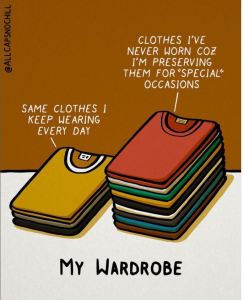
As I cleaned out my closet, I was taken aback by the sheer number of old clothes I discovered. I’m honestly baffled by how I ended up with so many clothes, and the crazy part is that I hardly ever wear most of them! It’s like they just sit there, gathering dust and occupying the space in my closet. Some could be repurposed for cleaning or other uses, but a significant amount remained. While we used to sell some of them in exchange for utensils, it made me wonder how other households dispose of their excess clothing.

Folded clothes
Photo: Corporat Comics

Instead of buying clothes based on what we actually need, we often get lured into grabbing them solely because of the tempting sales and discounts. It’s like our brains go into bargain-hunting mode, and before we know it, our closets are overflowing with impulse purchases. The rise of fast fashion has led to a significant upsurge in clothing purchases all around the globe. This surge can be attributed to various factors that have reshaped the industry.

Firstly, the globalization of fashion has played a pivotal role in making clothing more affordable and accessible to a wider range of consumers. The rapid expansion of fast fashion brands has perfectly tapped into this trend, offering stylish and inexpensive clothing options that are quickly churned out and easily discarded when no longer in vogue. Astonishingly, according to the Ellen MacArthur Foundation, the production of clothing has doubled over the past 15 years, reaching an astounding annual total of 100 billion garments.

The convenience of online shopping has revolutionized the way we purchase clothes, making it easier than ever before. With just a few clicks, one can browse through countless options and have items delivered right to their doorstep. Additionally, the power of social media cannot be underestimated when it comes to influencing shopping habits. The emergence of platforms like Instagram and TikTok has transformed the fashion landscape.

As individuals, we are constantly exposed to new trends and styles. The influence of fashion influencers on these platforms is undeniable, as they showcase the latest looks and inspire us to update our wardrobes. According to a survey conducted by Ipsos, a staggering 65% of consumers feel compelled to regularly refresh their clothing to keep up with ever-changing fashion trends.

Pile of clothes all dumped, messy

Despite the surge in clothing purchases, a significant chunk of these garments end up unused, as per a report by the Waste and Resources Action Programme (WRAP). Surprisingly, around 30% of the clothes hanging in the average person’s wardrobe remain unworn. The reason behind this pile-up of untouched clothes is a mix of factors that include our impulsive shopping habits, ever-changing fashion preferences, and the relentless pressure to stay on top of the latest trends. It’s a wild combination that leads to a wardrobe full of outfits we hardly ever wear.

The fashion industry and the disposal of unused clothes hold a significant responsibility for environmental pollution. Shockingly, approximately 10% of all clothing produced every year meets its untimely demise in landfills, accounting for a massive 92 million tons of discarded garments. As mentioned earlier, most discarded clothes end up in landfills, where they decompose and release methane, a potent greenhouse gas that contributes to climate change. Additionally, the decomposition process releases toxic chemicals from synthetic fabrics, further polluting the environment.

Moreover, the production of synthetic fabrics, such as polyester, contributes to water pollution. The production process involves the use of chemicals that can contaminate water sources, harming aquatic ecosystems and affecting human health. The UNEP estimates that the fashion industry is responsible for 20% of industrial water pollution globally.

There are several techniques that we can all use to reduce our impact on the planet. One effective way to achieve this is by embracing the concept of buying less clothing. It’s true that everywhere we turn, there are sales, flashy ads, and trends that make us want to splurge on new outfits. However, amidst all the temptation, we can make a conscious effort to try to rein it in.

Another alternative is to explore clothing rental services or borrowing options. Renting or borrowing clothes allows us to try out new trends and styles without committing to purchasing them outright. Additionally, supporting sustainable clothing brands is crucial. Many brands now focus on using recycled materials and implementing practices that have a lower environmental impact.

When we find ourselves no longer in need of certain clothing items, it is essential to donate them to charities or recycle them. By doing so, we actively participate in reducing the volume of clothing that ends up in landfills, thus mitigating the environmental harm caused by textile waste.

In a world where the seductive allure of fashion constantly entices, it requires strength to resist the urge for excessive clothing purchases. However, it is within our grasp to make a difference.

Cheers!

PS: BTW, what’s up with your wardrobe?

I do send out my posts to very few people. Join my mailing list if you enjoy what you read.

Deep Work, Deep Rest: The Ultimate Productivity Hack!

2–3 minutes
Two man working with laptops,
Photo by Marvin Meyer on Unsplash

Over the course of history, work has undergone a profound transformation. In earlier times, the majority of occupations revolved around physical labor, enabling individuals to develop a level of familiarity and perform tasks almost instinctively. However, in our modern era, work has evolved to emphasize intellectual and cognitive tasks that demand qualities like creativity, innovation, decision-making, and sustained mental engagement.

In today’s business landscape, competition has reached new heights due to globalization and technological progress. These factors have expanded market opportunities and increased the number of players striving for success. Businesses and individuals must continuously search for ways to stand out, innovate, and maintain a competitive edge. Surviving in the modern era extends beyond financial considerations alone. To remain relevant and meet the growing expectations, a significant amount of energy is required to embrace change, adopt new technologies, and remain adaptable in uncertain circumstances.

As individuals, we are often constrained to around four hours of focused and intense thinking per day, a concept known as “Deep work” according to Cal Newport. But, people often feel pressured to work excessively, sometimes exceeding 50, 80, 120 hours per week or even more. Indeed, it often leads to burnout, and choosing to rest in the midst of life’s busyness becomes an act of rebellion, pushing back against the never-ending demands placed on us.

Naval Ravikant offers an additional perspective on the same.

A lion and lioness in the forest
Photo by Wade Lambert on Unsplash

Nobody really works 80 to 120 hours a week at high output, with mental clarity. Your brain breaks down. You won’t have good ideas. The way people tend to work most effectively, especially in knowledge work, is to sprint as hard as they can while they feel inspired to work, and then rest. They take long breaks. It’s more like a lion hunting and less like a marathoner running. You sprint and then you rest. You reassess and then you try again. You end up building a marathon of sprints.Naval

In a world that values productivity above everything, embracing rest is like making a rebellious statement, declaring that our well-being matters most. Contrary to common belief, rest is not a hindrance to productivity; it is the catalyst that unlocks our true potential. It is through rest that we recharge our physical and mental capacities, enabling us to approach our tasks with renewed vigor and efficiency.

Rest when you’re weary. Refresh and renew yourself, your body, your mind, your spirit. Then get back to work.” – Ralph Waldo Emerson

Resting is all about taking a break, pausing, and engaging in activities that promote relaxation, rejuvenation, and recovery. It’s about intentionally stepping away from work or responsibilities to recharge ourselves physically and mentally. Resting can come in various forms, such as enjoying hobbies, practicing mindfulness, or simply taking time to do nothing at all. Its not about switching from meetings to Excel sheets or something else, which also requires focus and skill. By valuing and embracing rest, we can lead more balanced, fulfilling lives in an ever-changing and demanding world.

Cheers!

PS: How much rest is enough?

I do send out my posts to very few people. Join my mailing list if you enjoy what you read.
Tidy Up Your Headspace: Mental Decluttering Hacks!

2–4 minutes
A picture of men and women looking at each other

There was one popular show that was recently released on Netflix called Beef. That was the story of two individuals who got into a road rage incident. Both of them were feeling immense pressure from their day-to-day activities, and they allowed their anger and frustration to turn into aggression. This resulted in the loss of everything they had and worked for from the very beginning. This story highlighted the devastating consequences of not resolving issues within ourselves, especially when distressing feelings are left unaddressed and allowed to spiral out of control.

The human mind is constantly bombarded with a load of information from the media, social media, and personal experiences. All this information can accumulate over time and clutter our minds, making it difficult for us to focus on important goals. Just like a messy room can make it difficult to find things, a cluttered mind can lead to stress, anxiety, anger, etc. Therefore, it is important to remove unwanted things from the mind to stay focused and calm.

One of the main benefits of mental decluttering is improved cognitive function. When the mind is cluttered with unnecessary information, it can become overwhelmed and lose its ability to process new information efficiently. This can lead to forgetfulness, confusion, and difficulty in decision-making.

Another benefit of mental elimination is enhanced emotional balance. By removing unwanted things from the mind, it becomes easier to focus on positive thoughts and emotions, which can lead to a more positive outlook on life and improved mental health.

A smoke in black ground
Photo by Pascal Meier on Unsplash

There are several different methods that can be used for mental elimination.

#1 Writing down unwanted thoughts and emotions can help us externalize them and make them easier to deal with. This can be done through journaling, creative writing, or simply jotting down notes. Writing can also help organize thoughts and ideas, making it easier to process information and stay focused.

#2 Exercise and physical activity can also be used for mental elimination. Exercise releases endorphins, which are natural mood enhancers, and physical activities such as walking, running, etc can also help us distract the mind from unwanted thoughts and emotions.

#3 Meditation involves focusing the mind on a particular thought or object while eliminating other distractions. This can help us to clear the mind and reduce stress and anxiety.

#4 Spending time in nature or engaging in creative activities, such as painting or playing music, can help clear the mind and release suppressed emotions.

#5 Practicing gratitude is another way to shift our focus away from negative thoughts and emotions.

#6 Engaging in social activities and spending time with friends and loved ones can help us reduce stress and anxiety and provide a sense of support, relief, and community.

However, it is important to recognize that not all techniques may work equally well for everyone. What may be effective for one person may not necessarily be the same for another. Therefore, it is crucial to explore and experiment with different methods to find the one that works best for you personally. It may take some trial and error, but the effort is worth it when you find a technique that helps you achieve a clearer and more peaceful state of mind.

Cheers!

PS: Ending it with a verse from a song

ஓடும் தண்ணியில பாசியில்லையே
உணர்ச்சி கொட்டிபுட்டா நோயும் இல்லயே!

Don’t miss out! Get notified about new blog posts straight to your inbox !

Enter your email below to receive updates.

Hillside!

The picturesque hill station Ooty in Tamil Nadu, India, with its pleasant climate and lush greenery, attracts tourists seeking respite. Humans have the ability to modify their environment, but must also prioritize preservation for future generations.

2–3 minutes

Last week, I visited Ooty, which is a beautiful hill station located in the state of Tamil Nadu, India. It is surrounded by lush green valleys, misty hills, and tea plantations. The town has a pleasant climate throughout the year, which makes it a popular destination for tourists looking for a break from the heat of the plains.

A sunset picture
Photo by Sunandhini

Next to the place I stayed, there were carrot, strawberry, and beans. The air was fresh and surrounded by lush green hills—a breathtaking view. This place is usually crowded in the summer, but it was extra crowded on the weekends. Maybe people in the plains couldn’t tolerate the heat. There was too much traffic and crowds in most tourist spots. The heavy traffic on the hilly road released an unpleasant odor that mixed with the mist, making it suffocating to breathe.

There are so many animals in the area that have adapted to the environment since they can’t modify it, but we, as humans, have the ability to change it. The reason we can modify our environment to a greater extent than other animals is because of our higher level of intelligence and skill set.

Due to their limited abilities, some animals are not as capable as humans when it comes to modifying their environment. Consequently, these animals must adapt to their surroundings to survive. They depend on nature for their livelihood and therefore have a natural inclination not to damage it, unlike some humans. Some animals, however, do cause minor modifications to their surroundings, such as overgrazing or relocating rocks.

Early civilizations cleared forests for cultivation, and during the industrial revolution, the usage of machines increased, which led to the use of fossil fuels. The impact on nature has been particularly significant in the last century due to the increased population and expansion of industries.

It’s known fact that humans are just guests here on Earth, and our existence here is temporary. We are a small part of the planet’s vast ecosystem, and our actions have a significant impact on the environment. Although we have the ability to modify our surroundings to meet our needs, we must remember that we are not the only species on this planet.

People are becoming more aware of the importance of taking care of the environment and preserving natural resources for future generations. Governments, organizations, and individuals all over the world are working to develop sustainable practices and reduce the harm caused by human activities to nature.

Cheers

PS: Perhaps modifying the environment is ingrained in our genes for survival, rather than preserving it. (Lol)

I do send out my posts to very few people. Join my mailing list if you enjoy what you read.

Taxing Cows’ Burps and Farts: Climate Change!

Ruminant animals, like cows, produce methane and other greenhouse gases. Some propose taxing farmers for livestock emissions to combat climate change.

2–4 minutes

Did you know that burps and farts, which are common bodily functions, could potentially be subject to taxation? As governments and policymakers worldwide seek innovative approaches to address environmental issues like climate change, unconventional ideas, such as taxing emissions from these bodily functions of ruminants, have emerged. Let me explain.

Ruminant animals (which include cows, buffalo, sheep, goats, camels, giraffes, etc.) are mammals with a specialized digestive system where the stomach is divided into four chambers: the rumen, reticulum, omasum, and abomasum. Digestion is the process of breaking down food and absorbing the nutrients from it. However, the ability to break down food is not the same for all organisms. They quickly swallow the food, store it in their rumen for fermentation, and then regurgitate it back into their mouth for chewing through a process called rumination. It allows them to effectively digest the plant material. During the process, microbial fermentation breaks down the cellulose and hemicellulose into simpler substances.

A group of cows
Photo by Lomig on Unsplash

This fermentation process produces gases such as carbon dioxide (CO2) and methane (CH4) as byproducts. Methane is also released from them through burping while bringing food from the chambers for cud chewing or while farting. Apart from this, they also produce nitrous oxide (N2O) as a natural byproduct of their digestive and metabolic processes, primarily through urine and manure.

The emission of methane, carbon dioxide, and nitrous oxide is a potent greenhouse gases with global warming potential. However, it depends on various factors such as type of feed, diet composition, animal size, age, and health. Ruminant cattle can produce around 250–500 liters of methane per day. It is said that cattle feeding on fibrous such as grass or forage tend to produce more methane than others who fed on high concentrates. 

Ruminants naturally release greenhouse gases during their digestion, which is known as enteric fermentation. However, because methane is a powerful greenhouse gas that contributes to global warming, efforts are being made to find ways to reduce methane emissions from ruminants while keeping them healthy and productive. These efforts may involve improving their diet, making their food more efficient, and exploring genetic or dietary changes to reduce methane emissions during digestion.

An interesting and surprising proposal has been submitted to the New Zealand government, suggesting the taxation of farmers for their livestock’s emissions as a means to combat climate change. The country has a higher population of livestock (6.3 million) compared to its human population (5.1 million). Under the plan, farmers would need to cover the costs associated with the emissions of gases released by their animals, such as nitrous oxide from cattle urine and methane from cow farts and burps. Farmers may have the opportunity to offset their emissions and earn credits by planting crops, including trees, that help to reduce carbon emissions.

However, farmers would need to take responsibility for the environmental impact of their livestock, which includes emissions from cow burps and urine. They may also have the chance to earn credits by planting crops or trees to offset carbon emissions. These measures can help reduce the environmental impact of livestock production and address climate change. It’s important to explore innovative solutions and work together with policymakers and farmers to minimize greenhouse gas emissions from agriculture while maintaining sustainable farming practices.

Cheers!

Don’t miss out! Get notified about new blog posts straight to your inbox !  (No spam, pinky promise!)

Enter your email below to receive updates

Human Composting!

2–4 minutes

Compost is a dark, crumbly, and nutrient-rich material that is created through the natural decomposition of organic materials, such as food scraps, yard waste, crop residues, and animal manure. Composting is the process of intentionally managing and accelerating the decomposition of organic materials under controlled conditions to produce compost, which is used as a valuable soil amendment and fertilizer in agriculture, horticulture, and gardening.

Composting involves the breakdown of organic materials by microorganisms, such as bacteria, fungi, and other decomposers, into simpler organic compounds through a series of biological and chemical reactions. These microorganisms require oxygen, moisture, and the right temperature to thrive and decompose the organic materials. Composting can occur through aerobic (with oxygen) or anaerobic (without oxygen) processes, depending on the management practices and conditions.

Pit composting, vermicomposting, windrow composting, sheet composting, in-vessel composting, industrial composting, and bokashi composting are different types of composting we have heard of. The main raw materials for the above-mentioned techniques are food waste, dried plant parts, and animals wastes.

Human composting is the natural process when dead people are buried in the soil, and it takes days to decompose. It was quite shocking to learn and read about how it’s done artificially by a company called Recompose. The company history dates back to 2011, and operations began in Seattle around 2019. It is a relatively new and innovative process that involves the natural decomposition of human remains to create nutrient-rich compost. It is an alternative to traditional burial and cremation methods, and it is gaining attention. They are operating in very few places in the United States yet to branch out in other places.

The process of human composting followed by them are

#1. The body is laid into a vessel along with the wood chips, alfalfa, and straw. The amount of carbon, nitrogen, and oxygen in the vessel is controlled for the growth of essential microbes and bacteria that are involved in decomposition.

#2. After five to seven weeks, the organic material has been broken down into soil.

#3. The fresh soil is removed to a curing bin for several more weeks to age.

#4. After being aerated, the soil is screened to remove any non-organisms such as metal fillings, pacemakers, and artificial joint.

#5. Once completed, the soil can be used to enrich the land, and it is very similar to top soil..

I am not quite sure about the working and operations of vessels. Each body creates up to one cubic yard of soil and they are used in nurseries, forests, etc. The carbon dioxide emissions can be minimized compared to a cremation or conventional burial system. However, it may take some time for this approach to gain acceptance in other cultures and countries where burial and cremation practices are deeply rooted in tradition and beliefs.

As we continue to address waste management challenges and environmental sustainability, human composting presents an opportunity for a more eco-friendly and meaningful end-of-life option. It challenges our conventional notions of burial and cremation and encourages us to rethink our relationship with nature and our own mortality. It may require more patience and open-mindedness, but it holds the potential for a more sustainable and respectful approach to our final resting place on this earth. Nonetheless, composting remains a simple and effective way to reduce waste, conserve natural resources, and promote a circular economy, contributing to a more sustainable future for all.

Cheers!

I do send out my posts to very few people. Join my mailing list if you enjoy what you read.