#DecodeAgri19: Why agri graduates lag?

2–4 minutes

LinkedIn is buzzing with advice that agricultural graduates or the education ciricullam need to adapt to the agri-tech and startup ecosystem. True but slightly misplaced. Most of these students were never built for, nor placed in, that ecosystem.

Reality Check

B.Sc. (Hons) Agriculture is a four-year professional course. Before a decade, it existed almost entirely in government institutes and sub-campuses, private colleges had limited management seats. Students were largely from agri backgrounds or focused on competitive exams like IAS, where the degree offered an edge.

Course content is diverse, but placements were narrow. The seed, fertilizer, and pesticide sectors dominate hiring and favored men for fieldwork and travel. Salaries are modest. Compared to startups or business, exams like UPSC, TNPSC, SSC, Bank SO and more, remain more attractive for stability and pay. Even now.

Digital marketing and the startup boom are changing awareness. Success in agri-business requires the 3 C‘s: confidence, clarity, and capital. Graduates usually have confidence and clarity or the subject expertise but lack exposure to fundraising platforms and problem-solving in business contexts. Agri incubators at sub-campuses and NABARD funding exist, but growth is slow relative to tech.

Two Very Different Paths

Path 1: Tech Entrepreneurs in Agriculture

Building technology products to solve agricultural problems, where entrepreneurship and tech are core. We have few to quite alot now.

Example: soil-testing apps with IoT sensors, AI-based crop disease detection, marketplaces connecting farmers to buyers, raising VC funding and scaling fast.

Skills needed: Coding, product management, pitch decks, microeconomics, growth hacking.

The gap: Agri students haven’t learned coding, SaaS, or fundraising. it’s essentially a career change.

Path 2: Agriculture Experts Leveraging Technology

Deep domain knowledge is core, technology is a tool.

Example: improved farming practices using WhatsApp or simple apps, contract farming networks, value-added agri-products with tech-enabled logistics, and more.

Skills needed: Domain expertise, supply chain, farmer relationships, quality control, and growth.

The gap: Much smaller. Students have expertise; they need exposure to business fundamentals, basic digital tools, and access to working capital.

Why confusion happens?

Path 1 is popularised because it’s visible across all platforms, fits the disruption narrative, and scales theoretically faster. Tech entrepreneurs dominate the market. But most real agricultural impact will come from Path 2: biology, soil, and seasons can’t be hacked. Farmer trust comes from demonstrated expertise. Sustainable margins come from operational excellence, not just platform effects.

Path 2 needs incubators aligned with agricultural cycles (experimentation takes 6–12 months, not weeks), working capital for 3–5 years, mentorship, negotiations, partnerships, and market analysis

Agriculture itself is still largely untapped. Early adopters are entering, with rising focus on health and quality food. Once demand for quality food scales (maybe organic or natural), the sector will explode but unlike tech, it demands multiple stakeholders experts, farmers, labor & land, private tech, policymakers and markets.

The foundation is already there. With more experiential learning and exposure to business models, graduates can bridge traditional education and the emerging agri-economy if the system catches up. Most advice-givers don’t distinguish between the two. They often equate ‘agri-tech’ with tech entrepreneurship, while agriculture also greatly benefits from domain experts who apply technology thoughtfully rather than aiming solely to become startup founders.

Cheers!

Check out the previous post in Agriculture & latest post (The Stage Beyond Independence)

Follow on IG X for more!

If you like what you see and wish to support my work, then

Share your thoughts/suggestion at the comment section or mail at

randomwhyss[@]gmail[dot]com

Don’t miss out! Get notified about new blog posts straight to your inbox !

(No spam, pinky promise!)

Enter your mail to receive updates

The Stage Beyond Independence: Interdependence

1–2 minutes

I never got myself introduced to the word interdependence deeply enough. The only words I heard were dependence and independence. Dependence was framed as weakness. Independence was glorified as freedom. No one said there was a third stage, a higher one!

While reading The 7 Habits of Highly Effective People, the stages became clear. Human growth isn’t linear and it evolves through three distinct phases. Dependence → independence → interdependence. Each level demands mastery before the next one can begin. Dependence teaches survival (you do it for me). Independence teaches self-reliance (I can do it myself. Interdependence teaches creation (we can do it better together), the ability to build something larger than oneself.

Most people never move past independence. They confuse self-sufficiency with completion. But independence is still defensive. It’s about proving you don’t need anyone. Interdependence begins as a choice out of independence. At that stage, collaboration stops being transactional. It becomes generative. Win–win kinda strategy. It’s where your competence meets another’s and multiplies. It’s the evolution of independence.

Culture celebrates the lone achiever, not the integrated builder. Yet everything enduring ecosystems, partnerships, systems, nations runs on interdependence. Independence may make you good. Interdependence makes you scalable. Applies to all slices of life.

Cheers!

PS: can we call this as synergistic effect?

Check out the previous post: Randomness and Order

Follow on IG X for more!

If you like what you see and wish to support my work, then

Share your thoughts/suggestion at the comment section or mail at

randomwhyss[@]gmail[dot]com

Don’t miss out! Get notified about new blog posts straight to your inbox !

(No spam, pinky promise!)

Enter your mail to receive updates

Randomness and Order!

1–2 minutes

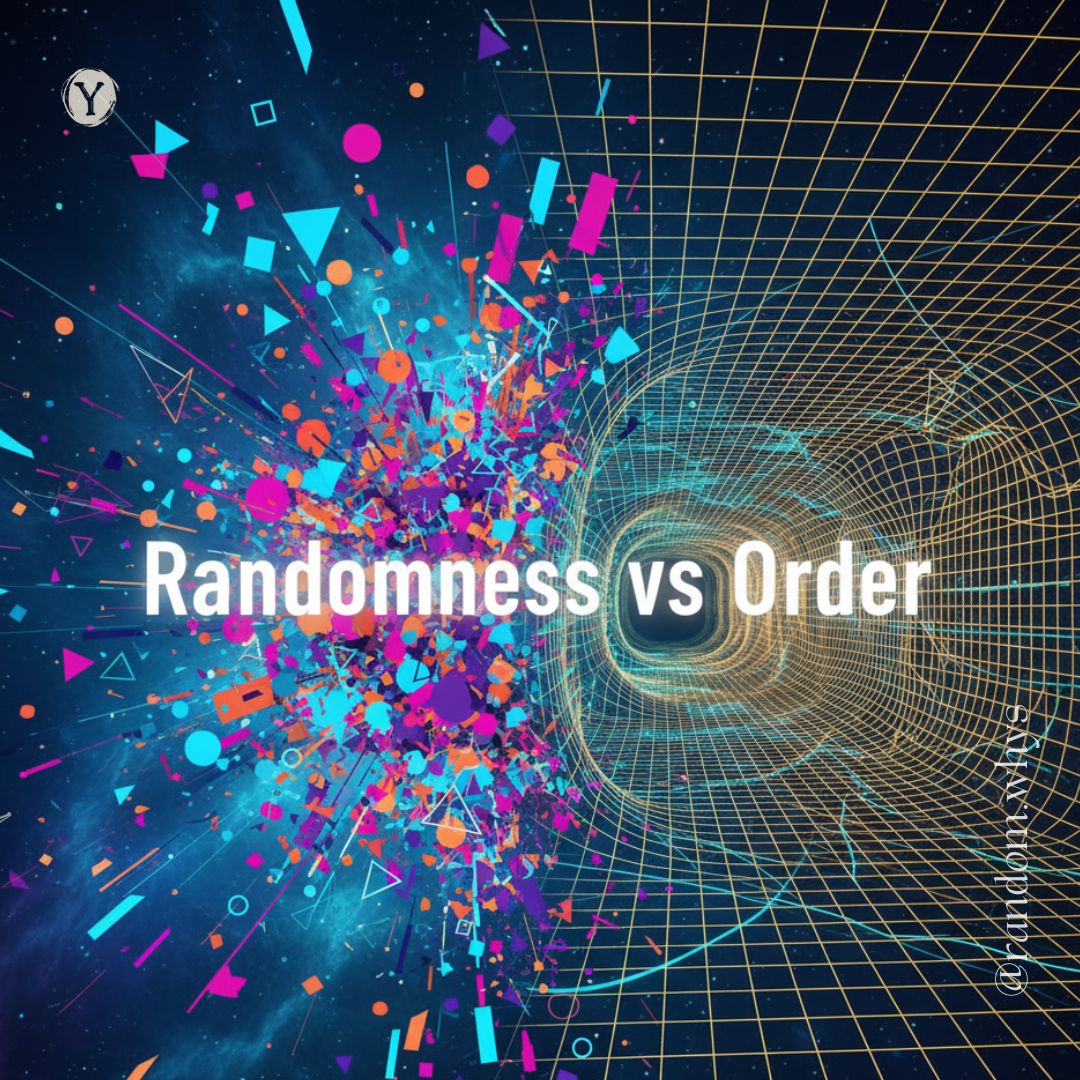
Order sharpens. Randomness breathes.

You can’t build anything without structure. For eg, work, routine, focus and more. Discipline pulls scattered energy into one stream. It’s what keeps the mind from dissolving into noise. When you start organising your work, your thoughts follow. Slowly, you become a system. The mind becomes an architect, efficient, precise, and predictable.

But that’s where the disorder begins. Too much order burns out the right brain or creative side. The one that dreams, experiments, and questions patterns. You start mistaking predictability for peace. The creative pulse dulls. The soul hungers for chaos, for the unknown.

That’s why randomness is not the enemy of order. It’s the antidote. The moments when you wander, explore, and break your own systems are what keep the mind alive. The art is not choosing between them. It’s knowing when to let one breathe through the other.

Cheers!

PS: Apologies for the absence!

Previous post: Flow State: F1

Follow on IG X for more!

If you like what you see and wish to support my work, then

Share your thoughts/suggestion at the comment section or mail at

randomwhyss[@]gmail[dot]com

Don’t miss out! Get notified about new blog posts straight to your inbox !

(No spam, pinky promise!)

Enter your mail to receive updates

Flow State: F1

1–2 minutes

Yesterday I watched F1. I don’t drive cars, never have. But the way Sunny says that he is chasing that one experience. He’s not chasing a trophy. He’s chasing that moment or the flow state. The constant roar of the engine fall silent, his thoughts disappear entirely, and the world shrinks down to the one bubble of focus. In that zone, he isn’t just driving, he is flying.

This is what psychologists call flow, a term proposed by Mihaly Csikszentmihalyi. It’s that state where the activity itself becomes rewarding, where effort feels effortless, and time and self seem to disappear.

Flow differs for everyone, depending on the balance of skill and challenge. It’s not impossible to reach, but it requires repetitions, practice, laps gradually training the mind and body until skill meets challenge naturally.

Flow isn’t magic. It’s skill meeting challenge, over and over, lap after lap. You don’t wait for it. You train for it. When it clicks, you just do. That’s flying. That’s flow.

Cheers!

Previous post: Why second things do matter!

Follow on IG X for more!

If you like what you see and wish to support my work, then

Share your thoughts/suggestion at the comment section or mail at

randomwhyss[@]gmail[dot]com

Don’t miss out! Get notified about new blog posts straight to your inbox !

(No spam, pinky promise!)

Enter your mail to receive updates

Why second things do matter!

1–2 minutes

In First Things First, we saw how survival comes before thriving. Secure the basics, and only then can the mind shift to growth.

But what comes after survival? That’s where Quadrant 2 enters the space of things that are important but not urgent.

Stephen Covey, in The 7 Habits of Highly Effective People (current read), maps life into four quadrants. Quadrant 2 is where the real magic happens. These activities don’t scream for your attention, but they quietly shape your future. Like eating well, moving your body, sleeping enough and caring for your mental health

They make up barely 20% of your daily life’s time, but they create 80% of your results. Ignore them long enough, and the system collapses.

In a tamil debate show where a youngster bragged about spending lakhs on an iphone while skipping meals. The phone might impress for a moment, but when health deteriorates, nothing else works.

This is the paradox! Urgent tasks grab us, but it’s the non-urgent, important ones that truly sustain us. Survival keeps the goose alive. Quadrant 2 keeps the goose healthy enough to lay golden eggs.

Second things do matter. Protect them, and everything else changes and sustains.

Cheers!

Previous post: How screens and spaces shape you?

Follow on IG X for more!

If you like what you see and wish to support my work, then

Share your thoughts/suggestion at the comment section or mail at

randomwhyss[@]gmail[dot]com

Don’t miss out! Get notified about new blog posts straight to your inbox !

(No spam, pinky promise!)

Enter your mail to receive updates

Why first things first!

1–2 minutes

We all want to thrive. To grow, to master, to live with purpose. But thriving is hard when the basics are shaky.

This is what I call the Survival–Thriving Law: the mind only shifts to thriving once survival is secured.

Think about it.

  • In yoga, you can’t master a pose until your foundation is steady. First balance, then grace.
  • In business, you can’t scale without cash flow in place. First stability, then growth. Not talking about startups here!
  • In life, you can’t chase purpose if you’re still worrying about daily survival. First safety, then meaning.

It feels like a paradox. We want to optimize for the end, yet the end collapses if we skip the mundae work throughout. We want the flower, but it only blooms if the roots are grounded.

So the order is non-negotiable. First survive, then thrive. Secure the basics, then let the mind expand.

Cheers

Previous post: #DecodeAgri06: Why traceability matters beyond exports?

Follow on IG X for more!

If you like what you see and wish to support my work, then

Share your thoughts/suggestion at the comment section or mail at

randomwhyss[@]gmail[dot]com

Don’t miss out! Get notified about new blog posts straight to your inbox !

(No spam, pinky promise!)

Enter your mail to receive updates

#DecodeAgri20: Why traceability matters beyond exports?

3–5 minutes

When you buy a packet of rice or a basket of mangoes in India, what do you really know about it? At best, you get a label with an FSSAI number and nutritional values. But where was it grown, how was it handled, what chemicals were used, and under what conditions did it travel before reaching you? Those answers are usually missing. This gap is what needs to addressed.

What Traceability Really Means?

Traceability is the ability to track the journey of food from farm to plate. Globally, it is the backbone of food safety systems. If contamination is found, a traceable chain allows quick recalls. If quality is questioned, it helps identify the source. It also builds consumer trust, because buyers know exactly where their food comes from.

Why Traceability is Hard in India?

India’s agriculture is too complex to make traceability simple. With over 85% of farmers being smallholders, land is fragmented and practices are diverse. Crops pass through multiple middlemen before reaching markets. Digital records are rare, logistics are inconsistent, and enforcement is patchy. While exports especially developed countries like EU, US demands rigorous monitoring, the domestic market is left to labels that say little about origin or safety.

Export Success, Domestic Neglect

To be fair, India has built successful traceability systems developed by APEDA. GrapeNet for pesticide monitoring in grapes, Peanut.Net for groundnuts, MangoNet for mango and Tracenet for organic consignments. These platforms came into picture as the foreign buyers demanded strict compliance. For Indians, the same grapes or groundnut lose their trace once they stay within the country.

Challenges faced

The absence of traceability is not only a farmer issue, it is systemic. For traceability to work, you need ground-level data: what inputs were used, how often, where, and when. That kind of data barely exists in Indian farming. Records are verbal, fragmented, or entirely missing. Certification and auditing come with costs and most smallholders cannot absorb. Supply chains, stretched across middlemen, don’t transmit information only the product itself.

Few days back, I watched a Tamil YouTube video on aflatoxin contamination in groundnuts based on the study conducted in districts of Tamil Nadu, showing how even staple crops can carry hidden health risks. At the same time, awareness about protein & fibre intake, diet, and health is rising sharply. Consumers are actively looking for healthier, higher-quality products.

Why It Matters Beyond Exports

The illusion holds until it doesn’t. Not standardized organic labels, unchecked pesticide residues, adulteration all remain common here. After COVID-19, Indian consumers have started seeking for food quality and safety. Traceability that exists for compliance abroad could be protecting health at home, but isn’t. There is now scope to deploy traceability domestically, making products genuinely safer and healthier.

Current Initiatives and Technology Opportunity

India has already shown that traceability systems can work GrapeNet for grapes, Peanut.Net for groundnuts,MangoNet for mangoes and Tracenet are proof. These platforms track quality, residues, and handling from farm to export, ensuring compliance with global standards. But they remain almost entirely export and commodity focused

The tools to extend traceability domestically are available and increasingly accessible. AI and blockchain can create records, while IoT sensors can monitor soil, water, and pesticide usage directly at the farm level. QR codes or farm management mobile apps can connect consumers to this data instantly. The challenge is not in technology itself, but in designing systems that work for India’s fragmented agriculture. Millions of smallholders, scattered plots, and multi-layered supply chains. With thoughtful implementation, these digital solutions could make traceability practical, affordable, and meaningful for every Indian consumer not just those buying exports.

Closing the Gap

Traceability in India has been treated as an export obligation, not a domestic right. That approach misses the point. The health of nearly 1.5 billion people is not secondary to the demands of foreign buyers. With rising awareness and demand for healthier, quality products, the lens will inevitably shift toward traceability. If India can build traceability for Brussels or Boston, it can build it for Bengaluru and Bhopal. What’s needed is a shift in intent from compliance for others, to accountability for ourselves.

Cheers!

Check out the similar posts: #Decodeagri05: Hidden costs of the rice revolution! & other Agri posts

Previous post: Taking responsibility without losing agency

Follow on IG X for more!

If you like what you see and wish to support my work, then

Share your thoughts/suggestion at the comment section or mail at

randomwhyss[@]gmail[dot]com

Don’t miss out! Get notified about new blog posts straight to your inbox !

(No spam, pinky promise!)

Enter your mail to receive updates

Taking responsibility without losing agency

1–2 minutes

Take responsibility is a phrase that gets thrown around so much it almost sounds like a cliché and terrfying. But it sets the foundation of personal agency. The ability to act, decide, and influence the direction of your own life.

The modern productivity and self-help world uses fancy words like playbook, high agency, proactive, center of influence, asymmetric bets, moat and more. They sound technical, even intimidating, but they all circle back to a simple thing. You always have a choice in how you respond, how you correct, and how you move forward.

Responsibility doesn’t mean controlling outcomes. You can’t force every situation to bend in your favor. It means owning the activity, the action itself, and knowing that the option to respond differently is yours. That’s the edge. Outcomes may vary.

It’s all about owning the input and the part where you have a real choice. That’s where agency lives.

Cheers!

Check out the previous posts: #Decodeagri05: Hidden costs of the rice revolution!

Follow on IG X for more!

If you like what you see and wish to support my work, then

Share your thoughts/suggestion at the comment section or mail at

randomwhyss[@]gmail[dot]com

Don’t miss out! Get notified about new blog posts straight to your inbox !

(No spam, pinky promise!)

Enter your mail to receive updates

#Decodeagri18: Hidden costs of the rice revolution!

3–5 minutes

I was trying to find an alternative to rice in my diet. At first, I thought lunch was the main issue. But when I traced it back, rice was everywhere. Breakfast, dinner, snacks, even in quick bites we don’t notice. That’s when it hit me. Rice isn’t just a grain on the plate but it has intricated into our entire lifestyle.

But this wasn’t always the case. Pre–Green Revolution, India was more millet country. In 1960, per capita millet consumption was around 30.9 kg/year, making up nearly 40% of cultivated grains. By 2022, that dropped to 3.8 kg/year and just 20% share of cultivation. Rice and wheat took over, reshaping not just what we eat but how our farms, markets, and health systems function.

Erosion of Agrobiodiversity

The Green Revolution was a band-aid and necessary to escape famine and achieve national self-sufficiency. But in the process, we lost sight of balance. Hybrid rice and wheat varieties were pushed aggressively, leading to the loss of over 100,000 indigenous rice varieties and countless traditional millet seeds. Each of those varieties carried resilience against pests, droughts, and climate swings.

The new seeds were designed for fertilizers and pesticides. Fertilizer use in India is projected to cross 160 kg per hectare by 2030, with some states already touching 250 kg/ha. Pesticide production hit 258,000 metric tons in 2023, applied over more than 108 million hectares. Farmers are trapped in a cycle more chemicals, declining soil health, shrinking microbial life, and polluted water.

The Shift on our plates & and in our bodies

Millets are rich in fiber, magnesium, and antioxidants, with a glycemic index of 52–68. White rice sits at 73, triggering sharp blood sugar spikes. The shift from complex, high-fiber millets to polished rice is directly linked to India’s rising diabetes burden. Multiple studies confirm that higher white rice consumption raises Type-2 diabetes risk, particularly in South Asian populations. In short, the grain that saved us from famine is now pushing us towards lifestyle disease.

Rice, methane, and the climate Story

It doesn’t stop at health. Rice paddies are major methane emitters. CH₄ emissions from Indian rice fields rose from about 3.7 teragrams (3.4–4.1 Tg) in 1966 to 4.8 teragrams (4.4–5.3 Tg) in 2017, largely driven by the expansion of rice area and conventional water regimes. Every plate of rice carries a hidden climate cost.

Millets, by contrast, are dryland crops. They thrive with little water, demand minimal inputs, and release negligible methane. They’re not just good for us, they’re good for the planet too.

The capitalist squeeze

The Green Revolution was also India’s industrial revolution in agriculture. Surplus production, mechanization, monoculture, and integration into global markets. Farmers who once saved seeds became buyers of hybrids they couldn’t replant. Multinationals selling fertilizers and pesticides turned farming into a business model.

Was the green revolution the mistake?

No. It was the need of the hour like a band-aid to stop famine and ensure national food sufficiency.

The mistake was never going back to rebuild what we lost. Millets could have been renewed, seed diversity could have been conserved, but policy and markets stayed stuck on rice and wheat.

Question of time and who cooks?

Even if we talk about bringing millets back, a practical question comes up. Who will cook them? Millets often need soaking, longer cooking, and extra attention. If we’re not careful, this shift risks pushing the responsibility back onto women, who already carry the weight of kitchen work. That’s not the future we want.

The real opportunity lies in innovation. With rice, we created an entire ecosystem, instant mixes, snacks, packaged foods, ready-to-cook and ready-to-eat products. Millets deserve the same treatment. From millet noodles to quick-cook flours, the scope is massive. This isn’t just about food, it’s a space for entrepreneurs, startups, and farmer collectives to build the millet economy. Convenience is what will make millets mainstream again.

Where do we go from here?

  • Bring millets into PDS, mid-day meals, and urban shelves.
  • Support community seed banks to revive traditional varieties.
  • Reform subsidies so they reward soil health, not just fertilizer use.
  • Make millets aspirational with recipes, ready-to-cook products, and modern branding.

The Green Revolution was the need of the hour. But what we forgot to do was renew millets alongside. We replaced a diversity-rich food culture with monocultures. We traded resilience for yields, and long-term health for short-term survival. Now we need a Nutritional Revolution that restores balance to our diets, our farms, and our future.

Cheers

Check out the previous posts: #DecodeAgri04: Who will grow the crops in a world obsessed with tech? & Why hardest way is the smartest way!

Follow on IG X for more!

If you like what you see and wish to support my work, then

Share your thoughts/suggestion at the comment section or mail at

randomwhyss[@]gmail[dot]com

Don’t miss out! Get notified about new blog posts straight to your inbox !

(No spam, pinky promise!)

Enter your mail to receive updates

Why hardest way is the smartest way!

1–2 minutes

The hardest part of problem-solving isn’t the problem itself. It’s resisting the urge to react on autopilot of blaming, fixing in a hurry, or slipping into victim mode.

We cannot solve our problems with the same level of consciousness that created them. – Einstein

Raising your consciousness isn’t an overnight upgrade. It starts with a pause. In that pause, ask: How would someone I deeply admire handle this? It could be a mentor, a parent, or even a figure you’ve never met.

The first time, your brain will resist. The second time, it will hesitate. But keep repeating it, and soon your mind learns a new default. Shifting perspective before reacting.

Cheers

Check out the previous post: Voice Over: Reality Check!

Follow on IG X for more!

If you like what you see and wish to support my work, then

Share your thoughts/suggestion at the comment section or mail at

randomwhyss[@]gmail[dot]com

Don’t miss out! Get notified about new blog posts straight to your inbox !

(No spam, pinky promise!)

Enter your mail to receive updates

Voice Over: Reality Check!

1–2 minutes

Recently I tried giving voice over for a note. I thought my voice was good enough even got compliments before so I assumed one take will be fine. I recorded and sent it, only to realize it sounded flat.

I didn’t understand the jargon people threw at me. I searched courses and YouTube, but they were all one-way. Nobody could point out what my mistake was. Finally, I came back to LLMs, kept recording different versions with different emotions, and even checked spectrograms. Slowly, I saw some changes, maybe 10% improvement.

I’m still learning, and I plan to add recordings to this as well.

The lesson?

Keep a reality check. Whatever lane you go in, stop and reassess. Compliments can be nice, but real growth happens when you see where you’re lacking and work on it.

Cheers!

PS: Might sound flat! IDK lol!

Check out the previous post: Bad Girl (2025) Movie Review

Follow on IG X for more!

If you like what you see and wish to support my work, then

Share your thoughts/suggestion at the comment section or mail at

randomwhyss[@]gmail[dot]com

Don’t miss out! Get notified about new blog posts straight to your inbox !

(No spam, pinky promise!)

Enter your mail to receive updates

Bad Girl (2025) Movie Review

4–6 minutes

This movie touched me personally. I think it will touch most girls and women irrespective of age.

Back in February, I watched the trailer. I couldn’t grasp much, but one dialogue between Ramya and her mom stayed with me: “Who will take care of you?” That question has been in my mind for a long time. My close circle knows this, we’ve often debated single life, married life, divorce, infidelity, and ended with different philosophies.

Most movies rarely portray women’s voices. They’re centered on men, his struggles, achievements, marriage, fights. Recently, some films have started focusing on women. Kannagi brought out the various stages of a woman’s life, but with more focus on her relationships and the spillover effects of choices. This movie is different, it centers more on Ramya and her mother, on the conditioning passed between them, and how women wrestle with themselves in silence.

The movie explores different stages of Ramya’s teenage life. The conversations are simple yet sharp. You feel it in the dynamics between her, her mother and grandmother. I often explain the love–hate relationship with mothers, and very few people get it. But this movie captured it raw and fresh. Maybe more, if ramya had a brother. We’ve had countless father–son movies, but rarely this.

From the beginning, Anjali fully lived the role of Ramya. Her first attraction, her questioning of “what’s wrong,” her desire to be with him, and her rebellion when parents separated them all felt real. In that same scene, both Ramya and her mother are questioned. Only Ramya tried to step out and managed to break the few tangles of the chain, but her mother cannot. Then Ramya falls for Arjun, a toxic pattern. She becomes self-focused, revolving around partners.

The friends’ roles were very well crafted. It showed how important a women’s circle is at every stage of life. The grandmother’s death revealed her conditioning yet felt the greif of her death. Ramya realizes she was never really single since her teens. Only when she chose herself stopping alcohol, fixing sleep, caring for her skin, did she start to shift.

I liked the re-entry of Nalan in her life. It made her question her choices. If she had married, she would be living the same life as Nalan, raising a child and carrying that routine. The writing around his character was strong. Among all male characters, Nalan stood out.

The scene where Ramya takes the baby out of the smoke during the function was powerful. The baby smiles in her arms but cries the moment it is taken back. A beautiful, simple metaphor for how conditioning works. This is where the “good girl syndrome” comes in the way women are conditioned to please, obey, and suppress their true emotions. It’s not just a cultural burden, research shows women who suppress anger, grief, or desire are more prone to stress-related health issues, including autoimmune diseases. Watching Ramya’s story, we could see how generations of suppression live in the bones of women.

The animals in the movie brought out two metaphors in the movie.

  1. Ramya is like a cat, seeking space from conditioning, relationships, and chaos. Yet at one point she says she enjoyed being taken along in a cab, shown with the picture of a dog revealing both sides of her.
  2. Ramya’s cat was her. Wandering, seeking freedom. Her mother kept trying to protect it, afraid it couldn’t survive outside. In the end, Ramya like the cat returned. Not in obedience, but in choosing connection on her own terms. It reminds me of how our feelings change over time like hating pink, then liking it again.

Over the years, I’ve realized mothers are also victims of conditioning, often without awareness. My perspective shifted. The lens changed. The movie shows the bigger picture, yet could’ve included the everyday details like no short dresses, not drying lingerie outside, wearing bindis and bangles, and more. I liked the climax. Many women, including me, were raised hearing: This is not your home. Your husband’s home is yours. But in reality, none of those feel truly ours. The movie emphasized the importance of having a woman’s own space.

The film doesn’t push a single choice. It shows women marrying, having children, divorcing all as possibilities. At the end, all you have is you to heal.

I also read a few reviews, including criticism. But I believe anything this raw will be criticized because it speaks the reality many don’t want to face. It’s about the life of an urban girl, which may differ for women raised in villages or tier-two and three cities. Some critics pointed out caste or other missing layers, but you can’t have too many main ingredients and still make a film with this kind of rawness and freshness. Its strength lies in its honesty, not in ticking every box.

Interestingly, on the morning before watching, my friend and I discussed habits, parents, meeting people, and routines. We were struggling to decide: do we need more alone time or constant socializing? Most of us are caught in this tug wanting to detach, but also wanting attachment. Not sure of car or dog or wanting both at various stands.

This film reflects that. Watch it, and you might see yourself too. The music was beautiful. I might rewatch it and come back here.

Cheers

Check out the previous post: Story Time #01: Layered! & Movie Reviews

Follow on IG X for more!

If you like what you see and wish to support my work, then

Share your thoughts/suggestion at the comment section or mail at

randomwhyss[@]gmail[dot]com

Don’t miss out! Get notified about new blog posts straight to your inbox !

(No spam, pinky promise!)

Enter your mail to receive updates

Story Time #01: Layered!

I went to trim my hair few days back.

But I met someone who didn’t feel routine at all.

She must be around 23 (confirmed later). Young, confident, and full of energy. I started a casual chat boredom usually makes me do that. Slowly the conversation went deeper… into life, into the things people usually don’t say out loud.

She doesn’t hold a degree. But she has years of experience in her lane. She knows exactly what she wants. She goes to the gym, takes her supplements, takes care of her body like anything. Routines doesn’t drain her you know!

Her clarity and thought process shook me. She grew up in a village in tier-2 city where her parents wanted her married off at 17. In her family, elders had married as early as 15 and were already raising adult children. She could have followed the same path. But she didn’t. She said no. She broke the script and building her own rules.

I went in expecting just a trim. I walked out carrying her story.

Sometimes, women like her don’t need saving. They just need someone to listen and to say out loud! You’re doing damn well!

Some build islands. Some carve the ground beneath their feet. Either way, we celebrate every woman who refuses to be moved.

Cheers!

PS: All these happened within an hour!

Check out the previous post: Cycle Syncing, Our Missing Map! The X2 club, Obscurity vs Cringe Posting!

Follow on IG X for more!

If you like what you see and wish to support my work, then

Share your thoughts/suggestion at the comment section or mail at

randomwhyss[@]gmail[dot]com

Don’t miss out! Get notified about new blog posts straight to your inbox !

(No spam, pinky promise!)

Enter your mail to receive updates

Obscurity vs Cringe Posting!

Fifteen years ago, what happened inside your walls stayed there. Neighbours had to work hard to even guess your new purchases, habits or lifestyle.

Today, obscurity is a luxury. Social media makes everyone visible, and strangers judge based on fragments. You’re either invisible or overexposed.

That leaves us with two real strategies:

1. Obscurity

Grow in Silence. When no one’s watching, you’re free. You can test, fail, rebuild, and nobody cares. It’s how every legendary thing starts, hidden in dorms, or quiet notebooks. Obscurity is freedom disguised as irrelevance.

2. Cringe Posting

Build in Public. The other path is the opposite. Post messy and raw, unpolished, even cringe. Let people mock. That noise makes you bulletproof. Over time, the critics fade, but your authenticity compounds. What starts as “cringe” becomes confidence.

The Only Mistake?

Trying to look polished too soon.

Stay obscure long enough to sharpen your edge. Or stay cringe until nothing can shake you. Each path fits a different lane. Choose the one that serves your goal.

Cheers!

Check out the previous post: Dogs, Humans, AI: What coexistence teaches us!

Follow on IG X for more!

If you like what you see and wish to support my work, then

Share your thoughts/suggestion at the comment section or mail at

randomwhyss[@]gmail[dot]com

Don’t miss out! Get notified about new blog posts straight to your inbox !

(No spam, pinky promise!)

Enter your mail to receive updates

Dogs, Humans, AI: What coexistence teaches us!

3–4 minutes

We think we control dogs. We think we will control AI. History shows coexistence is never one-sided. Yesterday, I watched a debate show on a popular Tamil channel. The topic was the rise of stray dogs, rabies cases, and public safety. At first, it looked like a heated argument, but very quickly I realized the show missed the real point.

Instead of inviting vet doctors to talk about rabies, or municipal officials to explain waste management and sterilization efforts, the stage was filled with two groups: victims of dog attacks and people who love and feed dogs. The media made it look like the problem was a fight between these two sides. In reality, the real issue is limited urban planning, healthcare, municipal responsibility, policies and bigger picture.

We all already know there are too many stray dogs. The real questions should be

  • Why is sterilization not scaled up?
  • Why is waste not controlled, attracting dogs in large numbers?
  • Why is rabies vaccination limited?

Without addressing these, the debate was just noise. Pure noise and diversion.

Why Dogs Are With Us in the First Place?

Thousands of years ago, humans were hunters and gatherers. Wolves began hanging around human camps because of leftover food and waste. Over time, the wolves that were less aggressive and more cooperative stayed closer, got food, and survived better.

Their guts adapted to human food even before their skulls and faces changed. Over time, they evolved into dogs not just serving humans as hunters and guards, but also shaping our emotions and daily lives. In many ways, dogs didn’t just get domesticated by us. They also domesticated us. They trained us to accept companionship (within home), loyalty, and emotional bonding with another species. It was also an extension of existing human social complexity.

Emotion vs Logic

In the debate, I saw major two emotions:

  • Fear and anger from victims.
  • Love and attachment from dog feeders.

Both are valid. But emotions cannot solve rabies. Only logic and policy can. Solutions are clear. Mass sterilization and vaccination programs. Better garbage control. Public awareness on rabies prevention. A humane system like the Dutch model, where strays are sterilized, sheltered, and adopted.

The AI Connection

Later that day, I listened to a podcast about birth rate decline and the rise of AI. A strange thought caught me as that tab was left open in my head. What if humans and AI end up like humans and dogs?

For thousands of years, dogs shifted from hunters and guards to pampered dependents fed, sheltered, and entertained by humans without needing to work. Today, AI is doing to humans what humans once did to dogs, taking over our roles, this time in cognitive work. Even dogs at risk!

The shift is happening at terrifying speed. Dogs had 30,000 years to adapt to dependence, humans may get just 30 years or less. Within a few decades, we could find ourselves in the dog’s position (Assumption or Sci fi or reality) living in comfort of AI-supported lifestyle first. Just as dogs today don’t understand the economic systems that feed them, maybe future humans might live comfortably while remaining fundamentally powerless in an AI-dominated economy.

But here is the difference. Gogs give something AI cannot yet replicate innocence, presence, and living in the moment. AI can fill intellectual gaps and even emotional ones, but it cannot replace the raw life energy of a living being.

The Bigger Lesson

Both stray dogs and AI show us the same truth: coexistence doesn’t happen by accident. It has to be managed. With dogs, poor management created today’s crisis. With AI, poor management could create tomorrow’s. In every case, the weaker side suffers most. Today it is dogs. Tomorrow, it could be us!

Cheers

Check out the previous post: The Bear and the tabs we keep open!

Follow on IG X for more!

If you like what you see and wish to support my work, then

Share your thoughts/suggestion at the comment section or mail at

randomwhyss[@]gmail[dot]com

Don’t miss out! Get notified about new blog posts straight to your inbox !

(No spam, pinky promise!)

Enter your mail to receive updates